
Modern machining often involves components that do not have standard round shapes. Aerospace parts, medical implants, automotive components, and custom-engineered products frequently feature unique profiles and challenging dimensions. In such situations, standard workholding solutions may not provide the required grip, accuracy, or stability.
Custom collets for non-standard workpiece geometries are specifically designed to address these challenges. They provide secure clamping, improved concentricity, and consistent machining performance for irregularly shaped parts.
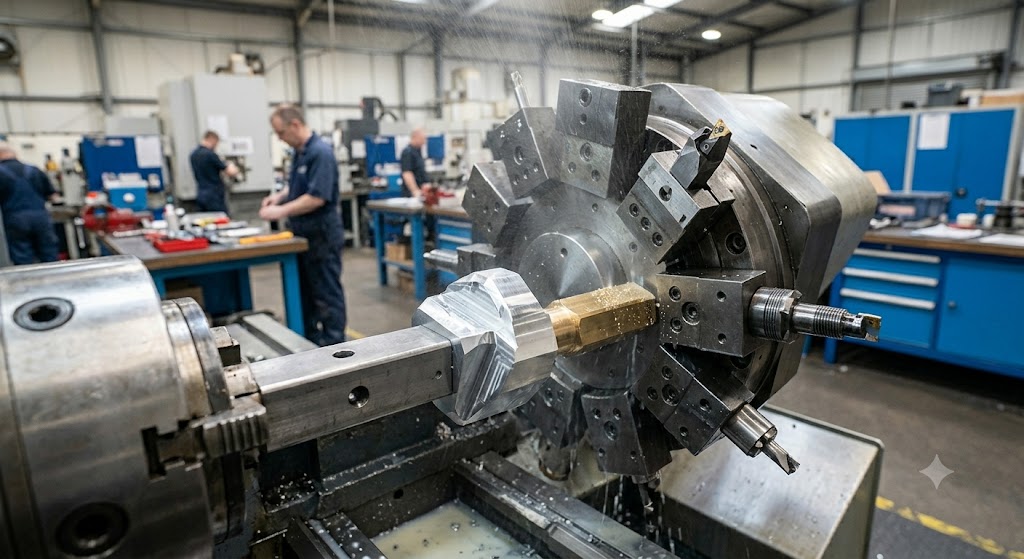
What Are Non-Standard Workpiece Geometries?
Non-standard workpiece geometries refer to components that cannot be effectively held using conventional round collets.
Examples include:
- Hexagonal shafts
- Square bars
- Oval components
- Tapered workpieces
- Thin-wall parts
- Complex aerospace profiles
- Medical implants
- Custom castings and forgings
These shapes require specialized gripping surfaces. This is where custom collets for non-standard workpiece geometries become essential.
Challenges of Machining Irregular Workpieces
Machining complex parts presents several difficulties.
- Uneven clamping pressure
- Workpiece slippage
- Surface damage
- Excessive vibration
- Poor dimensional accuracy
- Tool deflection
- Inconsistent surface finish
Standard collets are typically designed for cylindrical parts. When used on irregular profiles, they often fail to provide proper contact and grip.
As a result, manufacturers increasingly rely on custom collets for non-standard workpiece geometries to maintain production quality.
Why Standard Collets Are Not Always Suitable?
Standard collets work well for common applications. However, they have limitations when handling unique part profiles.
A standard collet may grip only a small portion of the workpiece. This creates uneven force distribution. The result can be runout issues, vibration, and premature tool wear.
Manufacturers looking for maximum precision often choose special collets designed specifically for their application.
Custom solutions improve gripping performance and reduce production risks.
Types of Custom Collets for Non-Standard Workpiece Geometries
Hex Collets
Hex collets are designed for hexagonal components. They provide full-profile contact and superior holding power.
Square Collets
Square collets securely clamp square bars and profiles. They prevent rotational movement during machining.
Step Collets
Step collets support multiple diameters within a single setup. They are ideal for complex parts with varying dimensions.
Expanding Collets
Expanding collets grip from the inside diameter of the component. They are commonly used when external surfaces must remain untouched.
Profiled Collets
These collets are fully customized to match the exact shape of a workpiece. They are widely used in aerospace and medical manufacturing.
Special Application Collets
Many industries require completely unique workholding solutions. In such cases, engineers design custom collets according to drawings and machining requirements.
Key Design Considerations for Custom Collets
The performance of custom collets for non-standard workpiece geometries depends heavily on proper engineering.
Important factors include:
- Workpiece shape analysis
- Contact area optimization
- Required clamping force
- Material hardness
- Machining speed
- Runout requirements
- Production volume
- Surface finish expectations
Proper design ensures maximum grip while minimizing deformation and vibration.
How Custom Collets Are Manufactured?
The manufacturing process begins with a detailed review of the workpiece drawing.
- Workpiece evaluation
- CAD design development
- Grip surface optimization
- Stress analysis
- Prototype production
- Performance testing
- Final manufacturing
High-precision grinding and CNC machining are used to achieve tight tolerances.
Advanced heat treatment processes help maintain elasticity and durability. The result is a highly reliable workholding solution.
Manufacturers also perform quality checks for runout, clamping force, and dimensional accuracy before delivery.
Materials Used in Custom Collet Manufacturing
Material selection significantly affects collet performance.
Common materials include:
- High-grade spring steel
- Alloy steel
- Tool steel
- Stainless steel
- Carbide-reinforced materials
The choice depends on machining conditions, workpiece material, and expected service life.
For demanding applications, manufacturers may also apply special coatings to improve wear resistance and corrosion protection.
Benefits of Custom Collets for Non-Standard Workpiece Geometries
Using custom collets for non-standard workpiece geometries offers several advantages.
- Higher machining accuracy
- Improved concentricity
- Reduced vibration
- Better surface finish
- Lower scrap rates
- Extended tool life
- Shorter setup times
- Improved productivity
- Enhanced process stability
These benefits make custom workholding solutions a valuable investment for precision manufacturing environments.
Custom Collets vs Standard Collets
| Feature | Standard Collets | Custom Collets |
|---|---|---|
| Geometry Support | Limited | Application-Specific |
| Clamping Accuracy | Moderate | High |
| Vibration Control | Average | Superior |
| Tool Life | Standard | Extended |
| Productivity | Normal | Higher |
Industries That Use Custom Collets
Custom collets for non-standard workpiece geometries are widely used across several industries.
- Aerospace manufacturing
- Medical device production
- Automotive engineering
- Defense manufacturing
- Electronics production
- Mold and die making
- Energy sector machining
These industries often require extremely tight tolerances and repeatable results.
Why Choose Sikka Precision Technologies?
Sikka Precision Technologies is a professionally operated and owned company producing high-quality precision collets for diverse machining applications.
The company uses high-quality steel to manufacture its extensive range of products. With years of industry experience, Sikka Precision Technologies focuses on delivering reliable workholding solutions that meet demanding machining requirements.
Manufacturers looking for precision-engineered collets can explore solutions such as ER Collets, 5C Collets, Traub Collets, and CNC Collet Chucks.
Address:
31/3F, Street No-1,
Anand Parbat Industrial Area,
New Delhi – 110005, India
Phone: +91-981-004-6365
Google Map Location:
View Location
Conclusion
As manufacturing continues to evolve, the demand for custom collets for non-standard workpiece geometries is growing rapidly. Standard workholding solutions cannot always meet the challenges posed by complex part profiles.
Custom-engineered collets provide superior grip, improved accuracy, reduced vibration, and enhanced productivity. For industries that depend on precision machining, investing in the right custom collet solution can significantly improve both product quality and operational efficiency.
Frequently Asked Questions
What are custom collets used for?
Custom collets are used to securely hold irregular, complex, or non-standard workpieces during machining operations.
Can custom collets improve machining accuracy?
Yes. They improve concentricity, reduce vibration, and provide more consistent clamping force.
Which industries benefit most from custom collets?
Aerospace, medical, automotive, defense, and electronics manufacturing industries frequently use custom collet solutions.
What materials are commonly used for custom collets?
Spring steel, alloy steel, tool steel, stainless steel, and carbide-reinforced materials are commonly used.
How do custom collets differ from standard collets?
Custom collets are designed specifically for unique workpiece geometries, while standard collets are intended for common shapes and dimensions.