
Stainless steel is one of the most reliable materials used in modern CNC manufacturing. It offers excellent strength, corrosion resistance, and long service life. These properties make it suitable for industries where precision and durability cannot be compromised.
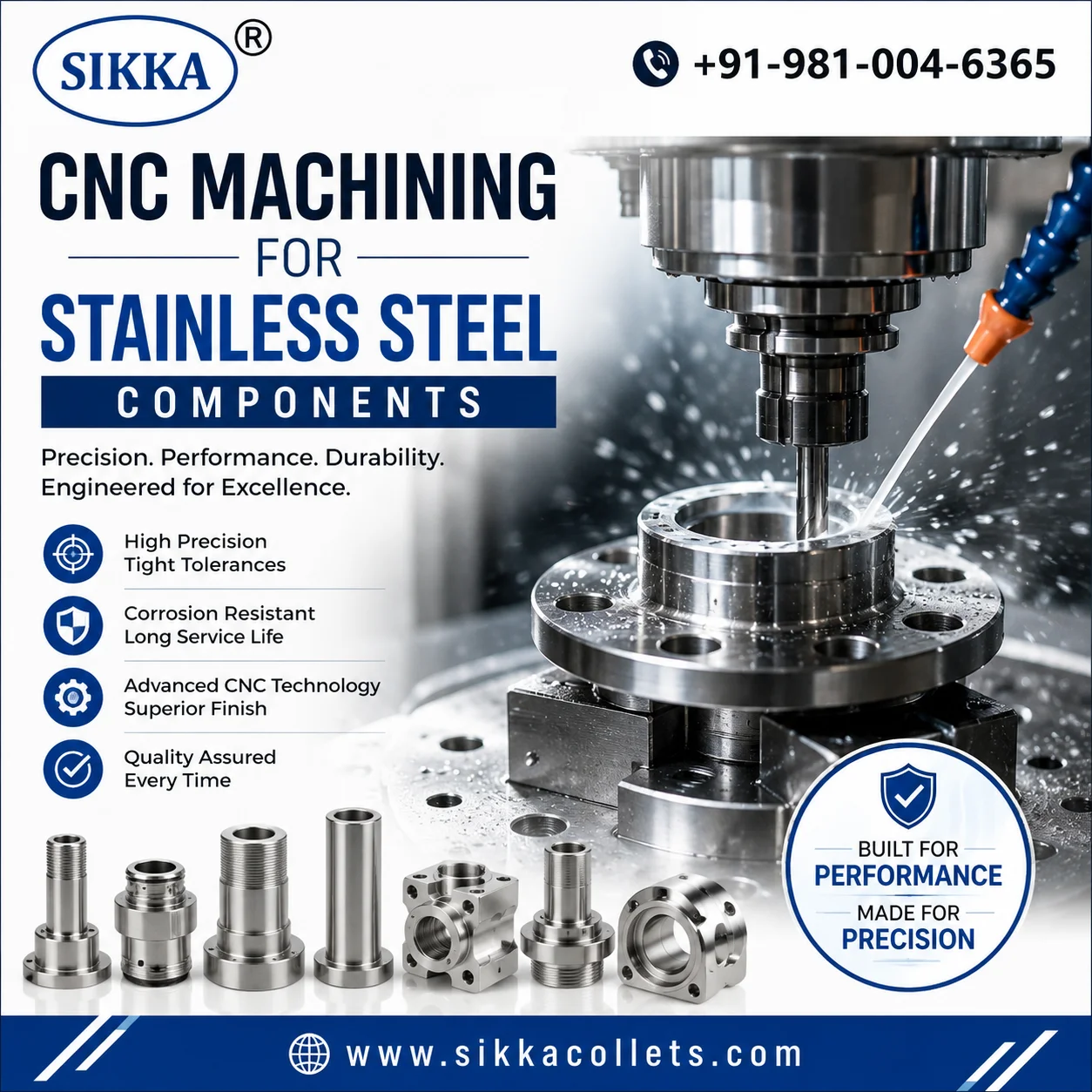
CNC Machining for Stainless Steel requires the right material grade, stable machining parameters, quality cutting tools, and an accurate tool holding system. Stainless steel generates more heat than many other engineering materials. It also work hardens quickly. Every stage of the machining process must therefore be carefully controlled to maintain dimensional accuracy and surface finish.
This guide explains how stainless steel components are machined, which grades are commonly used, the best machining practices, and the role of precision collets in maintaining machining accuracy.
Why CNC Machining for Stainless Steel Is Preferred
Many industries choose stainless steel because it performs well under demanding operating conditions. It maintains mechanical strength while resisting moisture, chemicals, and high temperatures.
Compared to mild steel, stainless steel offers better corrosion resistance. Compared to aluminium, it provides higher wear resistance and strength for critical applications.
Common benefits include:
- Excellent corrosion resistance
- High mechanical strength
- Long service life
- Good heat resistance
- Excellent dimensional stability
- Suitable for high precision CNC machining
- Compatible with multiple surface finishing processes
These advantages explain why CNC Machining for Stainless Steel is widely used for precision-engineered components across different industries.
Industries That Use CNC Machined Stainless Steel Components
Different industries select stainless steel grades according to operating conditions, environmental exposure, and mechanical requirements.
| Industry | Typical Components | Why Stainless Steel? |
|---|---|---|
| Medical | Surgical instruments, implant components | Corrosion resistance and easy sterilization |
| Aerospace | Precision brackets, hydraulic fittings | Strength and dimensional stability |
| Automotive | Shafts, nozzles, fuel system parts | Heat and wear resistance |
| Food Processing | Valves, fittings, machine components | Hygienic surface and corrosion protection |
| Oil & Gas | Pump parts, connectors, valve bodies | Chemical resistance |
| Industrial Manufacturing | Collets, fixtures, tooling components | Long operating life |
Common Stainless Steel Grades Used in CNC Machining
Selecting the correct material grade affects machining performance, tool life, production cost, and component durability.
303 Stainless Steel
303 is known for excellent machinability. Sulphur improves chip breaking and reduces cutting resistance. It is widely used for shafts, bushes, fittings, and precision turned components.
It is not the best choice for highly corrosive environments.
304 Stainless Steel
304 is considered the general-purpose stainless steel. It offers a good balance of corrosion resistance, strength, and fabrication capability.
Many industrial machine components are manufactured from 304 stainless steel.
316 Stainless Steel
316 contains molybdenum, which provides better resistance against chemicals, salt water, and harsh environments.
It is widely used in marine equipment, pharmaceutical machinery, and food processing applications.
17-4 PH Stainless Steel
This precipitation-hardening stainless steel provides excellent mechanical strength after heat treatment.
It is commonly selected for aerospace, defence, and heavy engineering applications where higher strength is required.
Stainless Steel Grade Comparison
| Grade | Machinability | Corrosion Resistance | Typical Applications |
|---|---|---|---|
| 303 | Excellent | Good | Precision turned parts |
| 304 | Good | Excellent | General engineering |
| 316 | Moderate | Excellent | Marine and food industries |
| 17-4 PH | Moderate | Good | High-strength industrial parts |
Understanding Stainless Steel Families
Not all stainless steels behave in the same way during machining. Their internal structure influences cutting performance, chip formation, hardness, and tool wear.
| Family | Main Property | Typical Applications |
|---|---|---|
| Austenitic | Excellent corrosion resistance | 304, 316 components |
| Ferritic | Good heat resistance | Automotive exhaust systems |
| Martensitic | High hardness | Cutting tools and wear parts |
| Duplex | High strength and corrosion resistance | Oil & Gas equipment |
| Precipitation Hardening | Excellent strength after heat treatment | Aerospace and defence parts |
Why Tool Holding Matters During CNC Machining for Stainless Steel
Stainless steel generates high cutting forces. Poor tool holding increases vibration, tool deflection, and runout. These issues reduce surface finish quality and shorten cutting tool life.
A precision tool holding system helps maintain machining accuracy throughout long production cycles.
For high-precision operations, many manufacturers use ER Collets because they provide consistent gripping force and improved concentricity. Different machining applications may also require dedicated collet chucks that match the spindle, tooling, and production requirements. These resources explain how proper tool holding contributes to machining stability and repeatable accuracy.
Common tool holding options include:
- ER Collets
- Hydraulic Holders
- Shrink Fit Holders
- Milling Chucks
- Precision Collet Chucks
The correct holder depends on spindle speed, cutting load, and required tolerance.
Best CNC Machines for Stainless Steel Components
The machine configuration has a direct impact on part accuracy, cycle time, and surface finish. Stainless steel requires a rigid machine structure because cutting forces are higher than aluminium or brass.
| CNC Machine | Best Application | Main Advantage |
|---|---|---|
| CNC Turning Center | Shafts, bushes, sleeves | High concentricity |
| Vertical Machining Center (VMC) | Plates, fixtures, brackets | Excellent milling capability |
| Horizontal Machining Center (HMC) | Complex multi-face parts | Better chip evacuation |
| Swiss-Type CNC Machine | Medical and miniature components | Outstanding precision |
| 5-Axis CNC Machine | Complex aerospace components | Single setup machining |
Machine rigidity, spindle stability, and proper workholding are equally important for maintaining tight tolerances during CNC Machining for Stainless Steel.
Common CNC Operations Used for Stainless Steel Components
Most stainless steel parts are produced using multiple machining operations. The sequence depends on component geometry and tolerance requirements.
- Precision Turning
- CNC Milling
- Drilling
- Boring
- Thread Milling
- Tapping
- Reaming
- Grooving
- Parting Operations
Every operation requires suitable cutting tools, stable clamping, and controlled cutting parameters.
Selecting the Right Cutting Tools
Tool material directly affects machining performance. Stainless steel creates high cutting temperatures and increases tool wear. Using the wrong cutting tool reduces productivity and increases machining cost.
| Tool Material | Recommended Usage |
|---|---|
| High-Speed Steel (HSS) | Light-duty machining |
| Solid Carbide | General CNC machining |
| Coated Carbide | High production machining |
| Ceramic Tools | High-speed finishing |
| CBN Tools | Hard stainless steel machining |
Coated carbide inserts are commonly selected because they provide better wear resistance and maintain cutting performance during long production runs.
Recommended Tool Holding for Better Accuracy
Even a high-quality cutting tool cannot perform properly if the tool holder introduces runout.
Precision tool holding systems improve spindle stability and reduce vibration during machining. Properly matched collets also help maintain surface finish and dimensional tolerance, especially while machining stainless steel components.
- Low runout
- Better gripping force
- Reduced vibration
- Longer cutting tool life
- Improved surface finish
Recommended Cutting Parameters
Actual cutting data depends on machine rigidity, insert geometry, coolant delivery, and stainless steel grade. The values below are only general starting references.
| Material Grade | Cutting Speed | Feed Rate | Coolant |
|---|---|---|---|
| 303 | Medium to High | Medium | Flood Coolant |
| 304 | Medium | Medium | High Pressure |
| 316 | Low to Medium | Moderate | High Pressure |
| 17-4 PH | Low | Controlled | High Pressure |
Trial machining should always be carried out before full-scale production to optimize cutting conditions for the specific component.
Common Challenges During CNC Machining for Stainless Steel
Stainless steel behaves differently from many engineering materials. Understanding these challenges helps improve productivity and reduce tooling costs.
1. Work Hardening
Stainless steel hardens rapidly if the cutting tool rubs instead of cuts.
Solution: Maintain continuous cutting. Use proper feed rates. Avoid tool dwell.
2. Excessive Heat Generation
Heat remains concentrated near the cutting edge because stainless steel has relatively low thermal conductivity.
Solution: Use high-pressure coolant and sharp carbide tools.
3. Rapid Tool Wear
Higher cutting forces reduce insert life during continuous machining.
Solution: Select coated carbide inserts and monitor tool wear before dimensional variation appears.
4. Poor Chip Evacuation
Long continuous chips can damage both the component and cutting tool.
Solution: Use chip breaker geometry and maintain proper coolant flow.
Troubleshooting Guide
| Problem | Possible Cause | Recommended Solution |
|---|---|---|
| Poor Surface Finish | Runout or worn insert | Inspect collet and replace insert |
| Tool Breakage | High cutting load | Reduce engagement and optimise feed |
| Built-Up Edge | Improper cutting speed | Adjust speed and coolant delivery |
| Excessive Burrs | Dull cutting tool | Replace insert and optimise tool path |
| Dimension Variation | Tool wear | Monitor offsets and inspect tooling |
Surface Finishing Options for Stainless Steel Components
Surface finishing improves appearance, corrosion resistance, and functional performance.
| Finish | Main Purpose |
|---|---|
| Bead Blasting | Uniform matte appearance |
| Polishing | Smooth surface finish |
| Passivation | Improved corrosion resistance |
| Grinding | Close dimensional tolerance |
Component functionality should always determine the finishing method instead of appearance alone.
Surface Roughness Reference
| Machining Process | Typical Surface Finish (Ra) |
|---|---|
| Rough Turning | 3.2–6.3 µm |
| Finish Turning | 0.8–1.6 µm |
| Grinding | 0.2–0.8 µm |
| Mirror Polishing | Below 0.2 µm |
Stable tool holding and accurate clamping play an important role in achieving these surface finish values. Shops looking to improve machining consistency can also review practical guidance on testing collet quality and proper collet handling and maintenance to reduce runout-related issues over long production cycles.
Quality Control for Stainless Steel CNC Components
Inspection is as important as machining. Even a well-machined component can fail if dimensional accuracy, concentricity, or surface finish is not verified before dispatch.
A structured inspection process helps maintain repeatability during both prototype and production batches.
Recommended Inspection Checklist
| Inspection Item | Purpose |
|---|---|
| Material Grade Verification | Confirms correct raw material |
| Critical Dimensions | Maintains drawing accuracy |
| Surface Finish | Checks functional quality |
| Runout Measurement | Verifies machining precision |
| Thread Inspection | Ensures proper assembly |
| Burr Removal | Improves safety and functionality |
| Visual Inspection | Detects scratches and machining marks |
| Final Packaging | Protects finished components |
Depending on the application, manufacturers may also use digital calipers, micrometers, height gauges, and coordinate measuring machines (CMM) for dimensional verification.
Design Tips That Improve Machining Efficiency
Good component design reduces machining time, tooling costs, and production delays. It also improves consistency across production batches.
- Avoid unnecessary deep pockets.
- Use standard drill sizes wherever possible.
- Add internal corner radii.
- Maintain uniform wall thickness.
- Avoid extremely tight tolerances on non-critical features.
- Design parts with proper tool accessibility.
- Specify only the surface finish required for the application.
These practices improve manufacturability without affecting component performance.
Factors That Affect the Cost of CNC Machining for Stainless Steel
The final machining cost depends on much more than raw material price.
| Factor | Impact on Cost |
|---|---|
| Stainless Steel Grade | Premium grades require more machining time |
| Part Complexity | Complex geometries increase cycle time |
| Tolerance Requirements | Tighter tolerances require additional inspection |
| Surface Finish | Secondary finishing operations increase cost |
| Batch Quantity | Larger batches reduce cost per component |
| Tool Wear | Higher wear increases tooling expenses |
Reviewing machining requirements during the design stage helps avoid unnecessary production costs.
Stainless Steel vs Other CNC Materials
| Material | Main Advantage | Typical Limitation |
|---|---|---|
| Stainless Steel | Strength and corrosion resistance | Lower machinability |
| Aluminium | Excellent machinability | Lower wear resistance |
| Carbon Steel | Lower material cost | Poor corrosion resistance |
| Brass | Easy machining | Lower mechanical strength |
| Titanium | High strength-to-weight ratio | Higher machining cost |
Material selection should always match the operating environment, strength requirements, corrosion exposure, and expected service life.
Precision Tool Holding Improves Stainless Steel Machining
Accurate machining depends on more than the CNC machine itself. Tool holding quality directly affects runout, vibration, surface finish, and cutting tool life.
Manufacturers using precision machining often evaluate the complete tool holding system instead of focusing only on cutting tools. Selecting the correct ER collet, maintaining proper clamping force, and replacing worn collets at the right time all contribute to better machining consistency. Additional guidance on balancing collet accuracy with tool life can also help reduce production issues during long machining cycles.
Frequently Asked Questions
Which stainless steel grade is easiest to machine?
Grade 303 generally offers the best machinability because it produces better chip control and lower cutting resistance than most other stainless steel grades.
Why is stainless steel difficult to machine?
It work hardens quickly, generates significant cutting heat, and creates higher cutting forces compared to many engineering materials.
Which coolant works best for stainless steel machining?
High-pressure coolant systems are commonly preferred because they improve cooling and chip evacuation around the cutting zone.
Can stainless steel components achieve tight tolerances?
Yes. Tight tolerances are achievable when rigid machines, quality tooling, stable workholding, and proper inspection procedures are used.
How does tool holding influence machining quality?
A precision tool holding system minimizes runout, improves cutting stability, reduces vibration, and helps maintain consistent dimensional accuracy.
About Sikka Sales Corporation
Sikka Sales Corporation manufactures precision collets and workholding solutions for CNC machining applications from its facility in New Delhi, India. The company supplies products for turning, milling, drilling, grinding, and other precision machining operations.
Address:
31/3F, Street No. 1,
Anand Parbat Industrial Area,
New Delhi – 110005, India
Phone: +91-981-004-6365
Google Business Profile:
View Verified Business Location
Conclusion
CNC Machining for Stainless Steel demands careful planning at every stage of production. Material grade selection, machine rigidity, cutting parameters, coolant strategy, tool holding, and inspection all influence the final component quality.
Choosing the correct stainless steel grade is only the first step. Consistent machining results also depend on stable workholding, accurate tooling, and disciplined quality control.
Shops that optimise these factors can improve productivity, reduce tool wear, achieve better surface finishes, and maintain tighter tolerances across both prototype and production batches.