
Understanding how coolant leakage affects collet performance is essential for improving machining accuracy, extending tool life, and reducing production costs. Even minor coolant leakage can create significant machining problems over time.
In modern CNC machining, precision depends on more than just the machine and cutting tool. Every component in the tool holding system plays a critical role. One often overlooked issue is coolant leakage. Many machine shops focus on spindle speed, feed rates, and tooling quality but ignore coolant loss occurring at the collet level.
This guide explains the causes, effects, and solutions for coolant leakage while highlighting the importance of high-quality ER steel sealed collets in modern CNC operations.
What Causes Coolant Leakage in Collet Systems?
Coolant leakage occurs when coolant escapes before reaching the cutting zone. This reduces cooling efficiency and affects overall machining performance.
Common causes include:
- Worn sealing rings
- Damaged collet slots
- Incorrect collet selection
- Improper tool diameter fitment
- Poor-quality collets
- Excessive coolant pressure
- Lack of maintenance
Standard collets are often unable to retain coolant effectively under high-pressure machining conditions. This is why many manufacturers now prefer ER collet systems designed for improved coolant control.
How Coolant Leakage Affects Collet Performance
Understanding how coolant leakage affects collet performance helps machine shops identify hidden productivity losses.
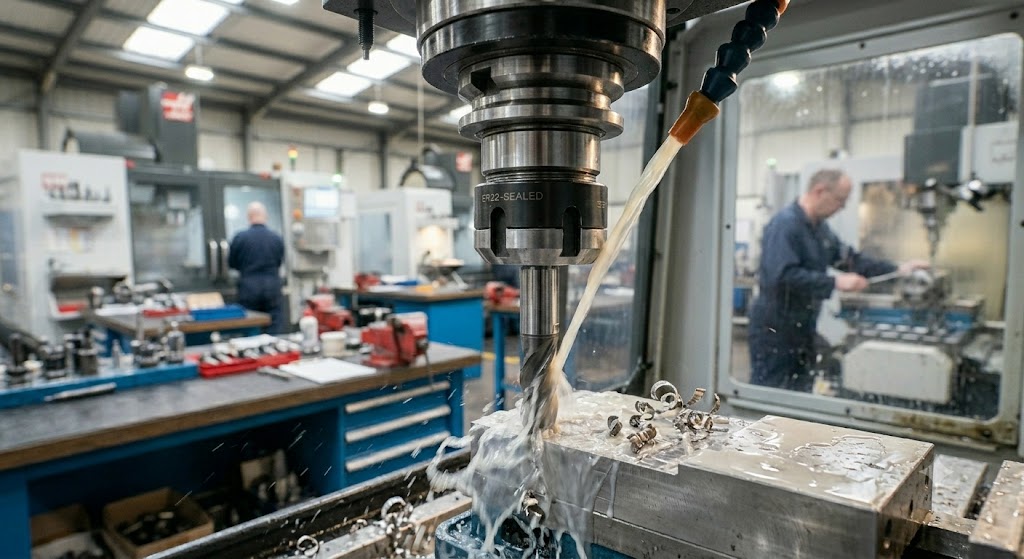
1. Reduced Coolant Delivery to the Cutting Edge
The primary purpose of coolant is to reach the cutting zone. When leakage occurs, coolant escapes through the collet slots instead of reaching the tool tip.
This leads to:
- Poor chip evacuation
- Increased friction
- Reduced cutting efficiency
- Higher tool temperatures
Deep-hole drilling and high-speed milling operations are especially vulnerable to coolant loss.
2. Increased Heat Generation
Heat is one of the biggest enemies of machining accuracy. When coolant fails to reach the cutting area, temperatures rise rapidly.
Excessive heat can cause:
- Thermal expansion
- Tool deformation
- Reduced dimensional accuracy
- Surface finish issues
This is one of the most significant ways how coolant leakage affects collet performance in precision machining applications.
3. Faster Tool Wear
Without adequate cooling, cutting edges wear out much faster. The tool coating may break down prematurely, and cutting edges can chip under excessive heat.
Common results include:
- Shorter tool life
- Frequent tool replacement
- Higher tooling costs
- Unexpected machine stoppages
Many CNC facilities invest in premium ER collets specifically to minimize these risks.
4. Poor Surface Finish
Coolant helps reduce friction between the cutting tool and workpiece. When leakage occurs, friction increases and surface quality suffers.
Operators may notice:
- Visible machining marks
- Rough finishes
- Built-up edge formation
- Inconsistent surface quality
Industries such as aerospace and medical manufacturing cannot afford these quality issues.
5. Reduced Collet Clamping Stability
Excessive heat generated by coolant leakage can affect tool holding stability. Thermal expansion and vibration may increase runout levels.
This can result in:
- Tool movement
- Poor concentricity
- Higher vibration
- Reduced machining precision
Proper collet clamping mechanisms are essential for maintaining accuracy.
6. Increased Machine Downtime
Machine downtime is expensive. Coolant leakage often creates a chain reaction of problems that lead to production interruptions.
These include:
- Frequent tool changes
- Quality inspection failures
- Scrapped components
- Production delays
This directly impacts profitability and operational efficiency.
Signs That Your Collet System Is Leaking Coolant
Early detection can prevent major machining problems.
Watch for these warning signs:
- Coolant spraying around the spindle area
- Excess coolant consumption
- Burn marks on machined components
- Poor chip evacuation
- Frequent tool failures
- Unexpected heat buildup
- Declining surface finish quality
If these symptoms appear, inspect the collet, holder, and sealing components immediately.
Standard Collets vs ER Steel Sealed Collets
| Feature | Standard Collet | ER Steel Sealed Collet |
|---|---|---|
| Coolant Retention | Limited | Excellent |
| High Pressure Coolant Support | Moderate | High |
| Tool Life | Average | Extended |
| Heat Control | Basic | Superior |
| Surface Finish Quality | Standard | Improved |
| Machining Consistency | Variable | Highly Consistent |
Many manufacturers now prefer sealed collets because they provide better coolant management and improved machining stability.
How Sealed Collets Prevent Coolant Leakage
ER Steel Sealed Collets are designed with integrated sealing systems that prevent coolant from escaping through the collet slots.
Benefits include:
- Improved coolant delivery
- Better chip evacuation
- Lower cutting temperatures
- Extended tool life
- Higher machining accuracy
- Reduced coolant waste
Machine shops looking to improve performance often upgrade their CNC tool holding systems with sealed collet solutions.
Best Practices to Prevent Coolant Leakage
Preventive maintenance is critical.
- Inspect sealing rings regularly.
- Replace damaged collets immediately.
- Clean collet slots after each production cycle.
- Follow proper torque specifications.
- Use the correct collet size.
- Invest in high-quality collets.
You can also review these collet handling and maintenance practices to improve long-term performance.
Why Quality Collets Matter
The impact of coolant leakage extends far beyond coolant loss. It affects machining accuracy, tool life, productivity, and operating costs.
Investing in premium collets provides:
- Consistent clamping force
- Improved concentricity
- Reduced vibration
- Enhanced coolant control
- Lower maintenance costs
- Long-term machining reliability
For demanding CNC applications, choosing quality collets is a cost-effective investment.
About Sikka Sales Corporation
Sikka Sales Corporation is a trusted name in precision collet manufacturing and supply. The company operates professionally under Sikka Precision Technologies and produces high-quality precision collets using premium-grade steel.
With extensive industry experience, the company supports CNC machining, milling, drilling, turning, and precision engineering applications requiring dependable tool holding solutions.
Address:
31/3F, Street No-1, Anand Parbat Industrial Area, New Delhi – 110005, India
Phone: +91-981-004-6365
Google Map Listing:
https://maps.app.goo.gl/iU6Ne2WKYp5DRZkP6
Learn more about the company here:
About Sikka Precision Technologies
Conclusion
Understanding how coolant leakage affects collet performance is essential for any CNC machining operation. Coolant leakage increases heat, accelerates tool wear, reduces surface finish quality, and creates unnecessary downtime.
Using high-quality ER Steel Sealed Collets helps eliminate these issues by maintaining efficient coolant flow directly to the cutting zone. The result is improved machining accuracy, longer tool life, lower operating costs, and greater production efficiency.
For machine shops focused on precision and productivity, investing in quality collets is one of the simplest ways to improve machining performance.