
Precision is the foundation of every high-quality collet. Even a few microns of dimensional variation can affect tool holding, increase runout, reduce machining accuracy, and shorten tool life. This is why Precision Grinding in Collet Manufacturing is considered one of the most critical stages in the production process.
Unlike conventional grinding, precision grinding removes a controlled amount of material to achieve extremely tight tolerances, superior surface finish, and excellent concentricity. A properly ground collet delivers stable clamping force, better repeatability, and reliable machining performance even during high-speed CNC operations.
At Sikka Precision Technologies, every grinding operation is carried out with strict quality standards. Our manufacturing process combines premium-grade steel, advanced grinding technology, and rigorous quality inspection to produce precision collets trusted by industries across India and international markets.
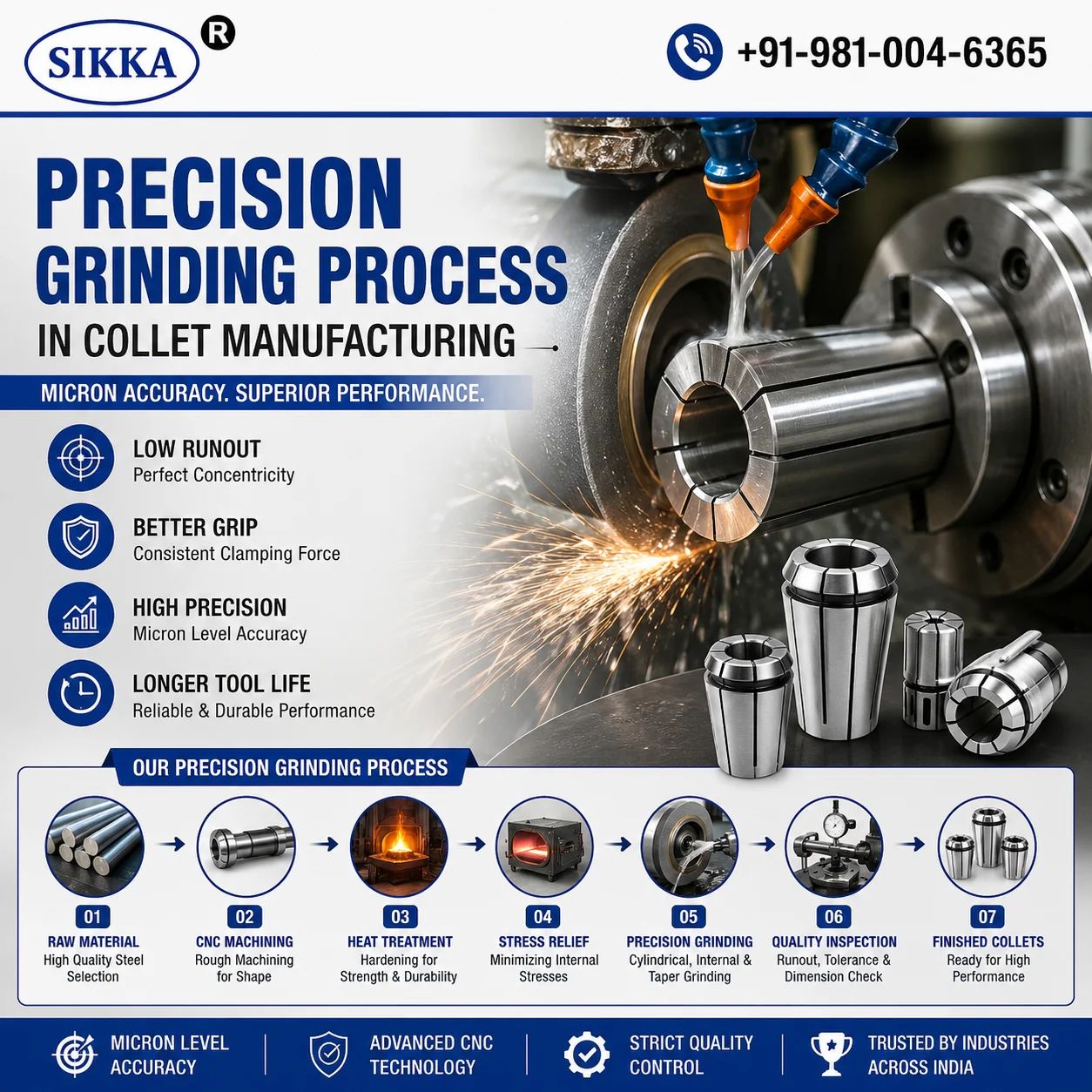
What is Precision Grinding in Collet Manufacturing?
Precision Grinding in Collet Manufacturing is a high-accuracy machining process used to achieve the exact dimensions, surface finish, and concentricity required for precision tool holding. During this process, a high-speed grinding wheel removes microscopic layers of hardened steel until every critical dimension falls within specified tolerances.
The objective is not simply to make the component smooth. The goal is to produce a collet that grips tools consistently, minimizes runout, and performs reliably throughout its service life.
A precision-ground collet offers:
- Excellent dimensional accuracy
- Low runout
- Superior surface finish
- Uniform gripping force
- High repeatability
- Longer operational life
Every micron matters. Even a slight grinding error can reduce machining accuracy and affect production quality.
Why Precision Grinding is Critical in Collet Manufacturing?
The quality of a collet depends heavily on the accuracy of its grinding process. Proper grinding ensures that the tool and spindle remain perfectly aligned throughout machining.
High-quality Precision Grinding in Collet Manufacturing helps achieve:
1. Reduced Runout
Runout directly affects machining accuracy. A precision-ground collet keeps the cutting tool centered, reducing vibration and improving dimensional consistency.
2. Better Tool Holding
A perfectly ground internal taper distributes gripping force evenly. This prevents tool slippage during heavy machining operations.
3. Improved Surface Finish
Stable tool holding produces cleaner cuts and smoother finished components.
4. Higher Repeatability
Every collet should perform consistently. Precision grinding ensures identical dimensions across production batches.
5. Longer Tool Life
Reduced vibration decreases cutting tool wear, resulting in longer tool life and lower production costs.
Complete Precision Grinding Process in Collet Manufacturing
The manufacturing of a precision collet involves several carefully controlled stages. Grinding is performed only after the material has been properly machined and heat treated.
Step 1 – High-Quality Steel Selection
The process starts with premium alloy steel selected for its strength, wear resistance, and dimensional stability. Material quality directly influences the final grinding accuracy.
Step 2 – CNC Machining
The raw steel is machined close to its final dimensions. At this stage, only rough dimensions are achieved. Final accuracy comes later during grinding.
Step 3 – Heat Treatment
The collet is heat treated to achieve the required hardness. Proper hardening improves wear resistance while maintaining structural integrity.
Step 4 – Stress Relief
Heat treatment can introduce internal stresses. Stress relief minimizes distortion before precision grinding begins.
Step 5 – Rough Grinding
Initial grinding removes excess material while preparing the component for finishing operations.
Step 6 – Finish Precision Grinding
This is the most important stage of Precision Grinding in Collet Manufacturing. Extremely small amounts of material are removed to achieve micron-level tolerances.
Special attention is given to:
- Outer diameter
- Internal bore
- Taper angle
- Concentricity
- Surface finish
Types of Grinding Operations Used in Collet Manufacturing
Different grinding techniques are combined to manufacture a high-performance collet.
Cylindrical Grinding
This process finishes the outer diameter of the collet with exceptional dimensional accuracy.
Internal Grinding
The internal bore is ground to ensure proper tool gripping and minimal runout.
Taper Grinding
Taper accuracy determines how well the collet seats inside the chuck. Precision taper grinding ensures full contact and stable clamping.
Surface Grinding
Critical flat surfaces are ground to improve assembly accuracy and dimensional consistency.
Final Finish Grinding
The final grinding pass removes microscopic imperfections and produces the required surface finish.
Machines Used for Precision Grinding
Modern Precision Grinding in Collet Manufacturing relies on advanced CNC grinding equipment capable of maintaining micron-level tolerances.
Common machines include:
- CNC Cylindrical Grinding Machines
- Internal Grinding Machines
- Surface Grinding Machines
- Automatic Measuring Systems
- Digital Inspection Equipment
These machines help maintain repeatable accuracy across large production batches.
Quality Inspection After Precision Grinding
Grinding alone does not guarantee quality. Every finished collet should undergo detailed inspection before dispatch.
Typical quality checks include:
- Runout measurement
- Concentricity inspection
- Surface roughness testing
- Outer diameter measurement
- Internal bore inspection
- Taper verification
- Roundness testing
Manufacturers that prioritize quality inspection consistently deliver reliable products. You can also learn more about how collet manufacturers ensure precision and durability and why inspection is essential during production.
Common Grinding Defects That Reduce Collet Accuracy
Even advanced grinding machines can produce defective collets if the grinding parameters are not properly controlled. Small errors during Precision Grinding in Collet Manufacturing can increase runout, reduce clamping force, and shorten the service life of the collet.
| Grinding Defect | Impact on Performance |
|---|---|
| Surface Burns | Weakens material and affects hardness. |
| Poor Surface Finish | Reduces gripping efficiency. |
| Incorrect Taper | Improper spindle seating. |
| Excessive Runout | Lower machining accuracy. |
| Wheel Marks | Poor contact between tool and collet. |
| Dimensional Variation | Inconsistent production quality. |
Proper machine calibration, wheel dressing, coolant control, and inspection help eliminate these defects.
Grinding Tolerance in Collet Manufacturing
The biggest advantage of Precision Grinding in Collet Manufacturing is the ability to achieve micron-level tolerances. Every critical dimension is controlled with extreme accuracy.
Maintaining tight tolerances offers several benefits.
- Better concentricity
- Reduced runout
- Uniform gripping force
- Higher repeatability
- Longer tool life
- Stable machining performance
Even a few microns of variation can negatively affect machining quality. That is why leading manufacturers invest heavily in advanced grinding equipment and inspection systems.
How Precision Grinding Improves Tool Performance
A properly ground collet improves the overall machining process.
- Reduces spindle vibration.
- Improves workpiece finish.
- Maintains consistent clamping force.
- Extends cutting tool life.
- Improves dimensional accuracy.
- Supports high-speed CNC machining.
- Minimizes production rejection.
- Reduces maintenance costs.
For industries where every micron matters, Precision Grinding in Collet Manufacturing plays a direct role in maintaining machining consistency.
Challenges During Precision Grinding
Producing high-quality collets is not simply about removing material. Several manufacturing challenges must be controlled throughout the grinding process.
- Heat generation
- Grinding wheel wear
- Machine vibration
- Thermal expansion
- Coolant contamination
- Improper wheel dressing
- Dimensional drift
Experienced manufacturers continuously monitor these parameters to maintain production accuracy.
Why Coolant is Essential During Precision Grinding
Coolant performs much more than simple lubrication. It protects both the grinding wheel and the workpiece.
During Precision Grinding in Collet Manufacturing, coolant helps:
- Reduce grinding temperature.
- Prevent surface burns.
- Maintain dimensional stability.
- Improve surface finish.
- Increase grinding wheel life.
- Reduce thermal distortion.
Proper coolant management contributes directly to the quality of every finished collet.
Precision Grinding vs Conventional Grinding
| Precision Grinding | Conventional Grinding |
|---|---|
| Micron-level accuracy | Standard accuracy |
| Excellent surface finish | Average finish |
| Very low runout | Higher runout |
| CNC controlled process | Mostly manual process |
| High repeatability | Limited consistency |
| Suitable for precision collets | General engineering components |
Industries That Depend on Precision Ground Collets
High-quality collets are used in industries where machining accuracy cannot be compromised.
- CNC machining
- Automotive manufacturing
- Aerospace engineering
- Medical device manufacturing
- Tool rooms
- Precision engineering
- Die and mould manufacturing
- Electronics industry
If your application requires consistent gripping performance, selecting the right collet for your machining needs becomes equally important.
How to Identify a High-Quality Precision Ground Collet
Before purchasing a collet, inspect these important quality indicators.
- Smooth surface finish.
- Accurate internal taper.
- Minimal runout.
- Burr-free slots.
- Uniform clamping pressure.
- Consistent dimensions.
- Premium hardened steel.
- Proper quality certification.
You can also read our guide on how to test collet quality before buying to make a better purchasing decision.
Why Choose Sikka Precision Technologies?
Sikka Precision Technologies is a professionally operated and owned company producing high-quality precision collets for industrial applications. We manufacture our complete product range using premium-grade steel, advanced production techniques, and strict quality control procedures.
Every stage of Precision Grinding in Collet Manufacturing is carefully monitored to achieve excellent dimensional accuracy, superior concentricity, low runout, and long service life.
Our experienced manufacturing team focuses on precision, consistency, and customer satisfaction. Every collet undergoes detailed quality inspection before dispatch to ensure dependable performance in demanding machining environments.
Businesses looking for reliable tool holding solutions can also explore our complete range of ER Collets and other precision-engineered products designed for CNC and automatic lathe machines.
Contact Information
Sikka Sales Corporation
31/3F, Street No. 1, Anand Parbat Industrial Area, New Delhi – 110005, India
Phone: +91-981-004-6365
Google Business Profile: View Our Google Map Location
Conclusion
Precision Grinding in Collet Manufacturing is the final process that transforms a machined component into a high-performance precision collet. Accurate grinding improves concentricity, minimizes runout, enhances gripping strength, and increases machining reliability.
Manufacturers that combine premium steel, advanced CNC grinding technology, strict inspection, and experienced engineering teams consistently produce collets that perform reliably across demanding industrial applications. Investing in precision-ground collets ultimately leads to better machining accuracy, longer tool life, improved productivity, and lower operating costs.
Frequently Asked Questions
1. What is Precision Grinding in Collet Manufacturing?
It is a high-accuracy grinding process used to achieve micron-level tolerances, excellent surface finish, and low runout in precision collets.
2. Why is precision grinding important for collets?
It improves gripping accuracy, reduces vibration, minimizes runout, and increases machining consistency.
3. Which machines are used for precision grinding?
CNC cylindrical grinders, internal grinders, surface grinders, and automated inspection systems are commonly used.
4. What materials are used for manufacturing precision collets?
Premium alloy steel and hardened tool steel are commonly used because of their strength and wear resistance.
5. What causes runout in a collet?
Incorrect grinding, poor taper accuracy, worn collets, contamination, and improper installation can all increase runout.
6. How does coolant improve grinding quality?
Coolant reduces heat, prevents burns, improves surface finish, and maintains dimensional stability.
7. How is grinding accuracy inspected?
Manufacturers measure runout, concentricity, roundness, taper accuracy, surface finish, and dimensional tolerances.
8. Which industries use precision-ground collets?
Automotive, aerospace, CNC machining, medical, electronics, mould manufacturing, and precision engineering industries.
9. What is the biggest advantage of precision grinding?
It produces highly accurate collets with excellent repeatability and longer service life.
10. How do I choose a quality precision collet?
Look for premium material, accurate taper, low runout, proper inspection, and a trusted manufacturer with proven experience.