
In precision machining, even a small amount of contamination can affect machining quality. Fine dust, metal chips, coolant residue, and oil deposits may look harmless. However, they can significantly reduce Collet Accuracy. A collet is designed to grip the cutting tool or workpiece with uniform pressure. When foreign particles collect inside the collet or spindle taper, the gripping force becomes uneven. This directly impacts Collet Accuracy, increases runout, and creates dimensional variations.
Many machine operators replace cutting tools when they notice poor surface finish or vibration. In reality, the actual problem is often hidden inside the collet. Regular inspection and cleaning help maintain Collet Accuracy, improve tool life, and prevent expensive machine downtime.
This guide explains how dust and chips affect Collet Accuracy, why regular cleaning matters, and what steps every machine shop should follow to maintain consistent machining performance.
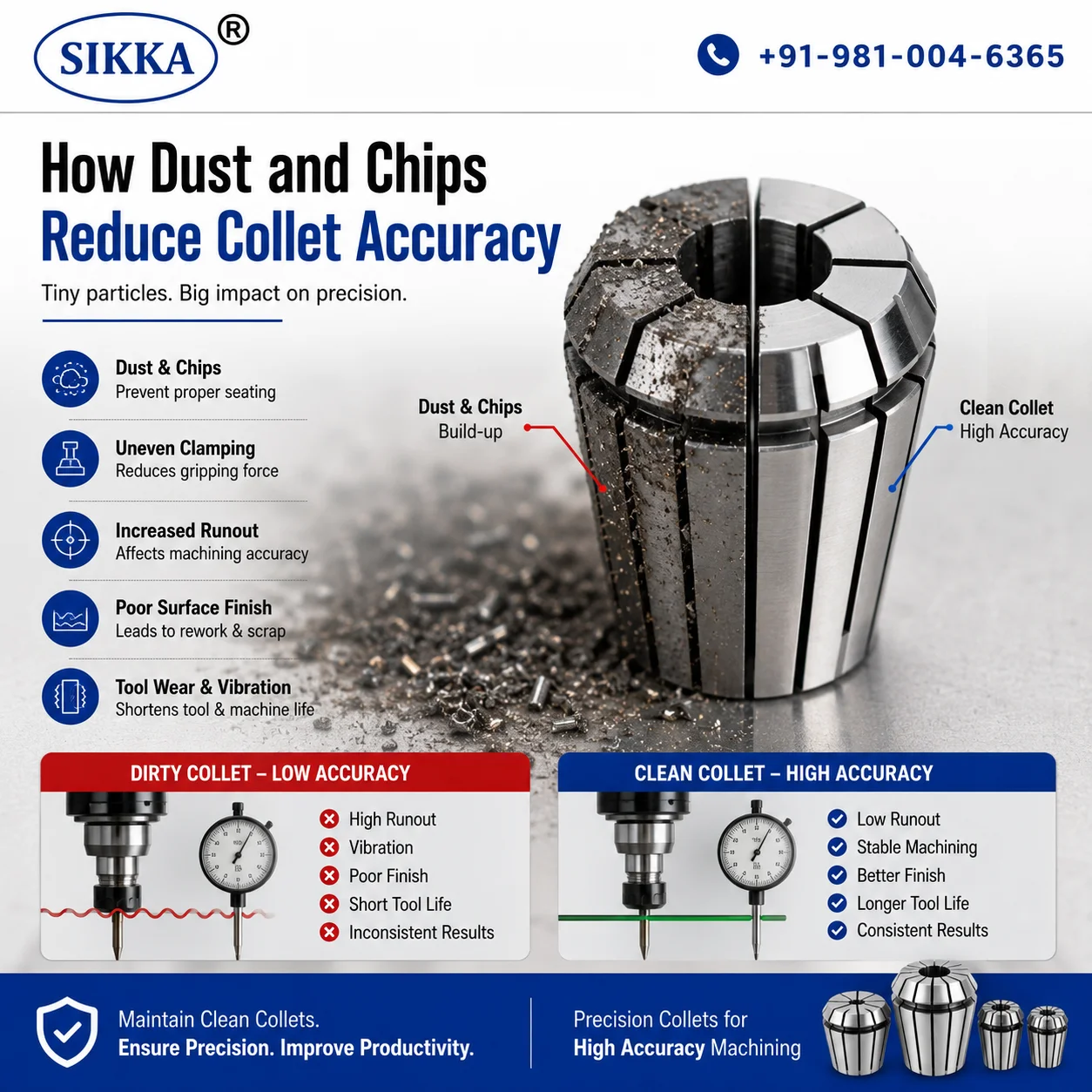
What is Collet Accuracy?
Collet Accuracy refers to the ability of a collet to hold a cutting tool or workpiece perfectly centered while maintaining consistent clamping pressure. A high-quality collet distributes gripping force evenly around the entire circumference of the tool. This ensures low runout, stable machining, and repeatable results.
When Collet Accuracy is maintained, manufacturers achieve:
- Better dimensional accuracy
- Lower tool runout
- Smoother surface finish
- Longer cutting tool life
- Reduced machine vibration
- Consistent production quality
Even microscopic contamination can disturb this precision. A few metal chips trapped between the tool and collet can shift the tool centerline by several microns. This is enough to affect high-precision machining applications.
How Dust and Chips Reduce Collet Accuracy?
Dust and chips are among the most common reasons behind poor Collet Accuracy. Every machining cycle produces fine metal particles, grinding dust, coolant residue, and oil contamination. If these contaminants are not removed before installing the tool, they prevent the collet from seating correctly.
Instead of applying uniform 360-degree gripping pressure, the collet grips unevenly. This immediately reduces Collet Accuracy and creates machining problems.
Dust Creates Uneven Contact Surfaces
Fine dust particles settle inside the collet slots, spindle taper, and collet nut. Although these particles are extremely small, they create an uneven contact surface between the tool and the collet.
As a result:
- The tool does not sit perfectly.
- Clamping pressure becomes uneven.
- Tool runout increases.
- Machining vibration starts.
- Collet Accuracy decreases.
This problem becomes even more critical during high-speed CNC machining, where precision is measured in microns.
Metal Chips Prevent Proper Seating
Metal chips are harder than dust and create even bigger problems. A single chip trapped inside the collet can prevent complete seating of the tool.
Instead of gripping uniformly, the collet applies pressure only at a few points. This uneven gripping affects Collet Accuracy and increases the chances of tool movement during machining.
The result may include:
- Tool slippage
- Poor concentricity
- Excessive vibration
- Incorrect dimensions
- Reduced machining quality
How Contamination Affects Clamping Force
The primary function of any precision collet is to generate uniform clamping force. Clean contact surfaces allow the collet to compress evenly around the cutting tool.
When contaminants enter the clamping area, the gripping force becomes inconsistent.
| Clean Collet | Dirty Collet |
|---|---|
| Uniform 360° gripping | Uneven gripping pressure |
| Low tool runout | Higher runout |
| Stable machining | Tool vibration |
| Accurate dimensions | Dimensional variation |
| Better tool life | Frequent tool wear |
| Excellent surface finish | Rough surface finish |
Maintaining clean contact surfaces is one of the simplest ways to preserve Collet Accuracy throughout daily production.
The Hidden Impact on CNC Machine Performance
Many operators focus only on cutting tools. They often overlook the condition of the collet. Poor Collet Accuracy affects much more than the tool itself.
Contaminated collets increase mechanical stress across the complete machining system.
Common consequences include:
- Higher spindle load
- Increased bearing wear
- Machine vibration
- Longer machining cycles
- Frequent tool replacement
- Reduced production efficiency
- Unexpected machine downtime
Over time, these small issues become expensive maintenance problems. A five-minute cleaning routine can often prevent hours of production loss.
Dust, Chips, and Coolant Residue: Which Causes the Most Damage?
| Contaminant | Impact on Collet Accuracy | Recommended Action |
|---|---|---|
| Fine Dust | Creates uneven contact surfaces | Clean using compressed air and a soft brush. |
| Metal Chips | Prevents proper seating of the tool | Inspect every slot before installation. |
| Coolant Residue | Reduces gripping consistency | Wipe dry before assembly. |
| Oil Deposits | Allows tool movement under load | Use approved cleaning solution. |
| Rust Particles | Damages contact surfaces | Replace damaged collets immediately. |
Choose High-Quality Collets for Consistent Accuracy
Cleaning is only one part of maintaining Collet Accuracy. The quality of the collet also plays a major role. High-quality precision collets are manufactured with tight tolerances, premium steel, and accurate heat treatment. These features improve gripping stability and reduce runout.
If you are selecting new collets for CNC applications, read our guide on choosing the right collet for your machining needs.
You can also learn more about maintaining proper tool holding performance by reading our guide on best practices for collet handling, cleaning, and replacement.
For users working with CNC machining centers, our detailed article on why collet chucks are important for high-precision machining explains how proper tool holding directly improves machining consistency.
Signs That Dust and Chips Are Affecting Collet Accuracy
Many machining problems start with a dirty collet. Unfortunately, these signs are often mistaken for cutting tool failure. Before replacing the tool, inspect the collet carefully.
The following symptoms usually indicate poor Collet Accuracy caused by contamination.
- Unexpected tool runout
- Poor surface finish
- Tool slipping during machining
- Inconsistent component dimensions
- Higher machine vibration
- Abnormal spindle noise
- Frequent tool breakage
- Difficulty inserting or removing the tool
If one or more of these issues appear repeatedly, inspect the collet, collet nut, and spindle taper before changing machining parameters.
Industries Where Collet Accuracy Is Critical
Maintaining Collet Accuracy is essential in industries where components are manufactured with tight tolerances.
- Automotive Manufacturing
- Aerospace Engineering
- Medical Device Manufacturing
- Precision Tool Rooms
- Die & Mold Manufacturing
- Oil & Gas Components
- Electronics Manufacturing
- General CNC Production
Even a few microns of tool movement can lead to rejected parts, additional machining time, and higher production costs.
Step-by-Step Cleaning Process to Maintain Collet Accuracy
A simple cleaning routine can significantly improve Collet Accuracy. Follow these steps before installing every cutting tool.
- Remove the collet from the holder.
- Inspect the inside and outside surfaces.
- Check every slot for trapped chips.
- Use a soft nylon brush to remove loose particles.
- Blow compressed air through every slot.
- Clean the spindle taper carefully.
- Remove coolant and oil residue using a lint-free cloth.
- Inspect for cracks, wear, or deformation.
- Reinstall the collet correctly.
- Tighten using the recommended torque.
Never use hard metal tools to scrape contamination from the collet. This may damage precision contact surfaces and permanently reduce Collet Accuracy.
Daily Collet Inspection Checklist
| Inspection Item | Status |
|---|---|
| Collet cleaned | ✔ |
| Slots free from chips | ✔ |
| No coolant residue | ✔ |
| No visible cracks | ✔ |
| No rust or corrosion | ✔ |
| Tool seated correctly | ✔ |
| Torque applied correctly | ✔ |
| Runout checked | ✔ |
Following this checklist every day helps maintain consistent Collet Accuracy and reduces unexpected machine stoppages.
Common Mistakes That Reduce Collet Accuracy
- Installing tools without cleaning the collet.
- Ignoring fine metal chips inside the slots.
- Using worn or damaged collets.
- Over-tightening the collet nut.
- Using incorrect collet sizes.
- Skipping regular inspection.
- Leaving coolant residue after machining.
- Continuing to use cracked collets.
Correcting these simple mistakes can improve machining consistency and extend tool life.
Frequently Asked Questions
Can dust really reduce Collet Accuracy?
Yes. Fine dust creates uneven contact surfaces between the tool and the collet. This increases runout and reduces gripping consistency.
Do metal chips affect clamping force?
Yes. Metal chips prevent proper seating of the tool. This creates uneven clamping pressure and reduces machining precision.
How often should a collet be cleaned?
For high-precision machining, inspect and clean the collet before every tool change. In normal production, cleaning once every shift is recommended.
Can coolant residue affect machining accuracy?
Yes. Coolant residue reduces friction consistency between contact surfaces and may lead to tool movement during machining.
When should a collet be replaced?
Replace the collet immediately if you notice cracks, permanent deformation, excessive runout, rust, or reduced gripping performance.
Why Choose Sikka Precision Technologies?
Sikka Precision Technologies is a professionally owned and operated manufacturer of precision collets. We manufacture a wide range of high-quality collets using premium-grade steel and advanced manufacturing processes. Every product is designed to deliver excellent gripping performance, long service life, and dependable Collet Accuracy for demanding machining applications.
Our precision collets are widely used across CNC machining, turning, milling, drilling, automotive, aerospace, medical, and general engineering industries where accuracy and repeatability are essential.
To understand how premium-quality collets improve machining performance, read our guide on Why Choose Sikka Collets for CNC Applications.
You can also explore our complete range of ER Collets and Collet Chucks for precision machining applications.
Conclusion
Maintaining excellent Collet Accuracy does not always require expensive equipment. Regular cleaning, proper inspection, and timely replacement of worn collets can prevent most machining problems before they occur.
Dust, chips, coolant residue, and oil deposits may seem insignificant, but they directly affect gripping force, tool runout, surface finish, and machining consistency. A clean collet not only improves productivity but also protects cutting tools, spindle components, and finished parts.
If your goal is consistent precision machining, make collet inspection and cleaning a standard part of every setup.
Contact Sikka Precision Technologies
Sikka Sales Corporation
31/3F, Street No. 1, Anand Parbat Industrial Area, New Delhi – 110005, India
Phone: +91-981-004-6365
Google Maps: View Our Manufacturing Location
If you are looking for high-quality precision collets that deliver reliable Collet Accuracy, our team will be happy to help you select the right solution for your machining requirements.