
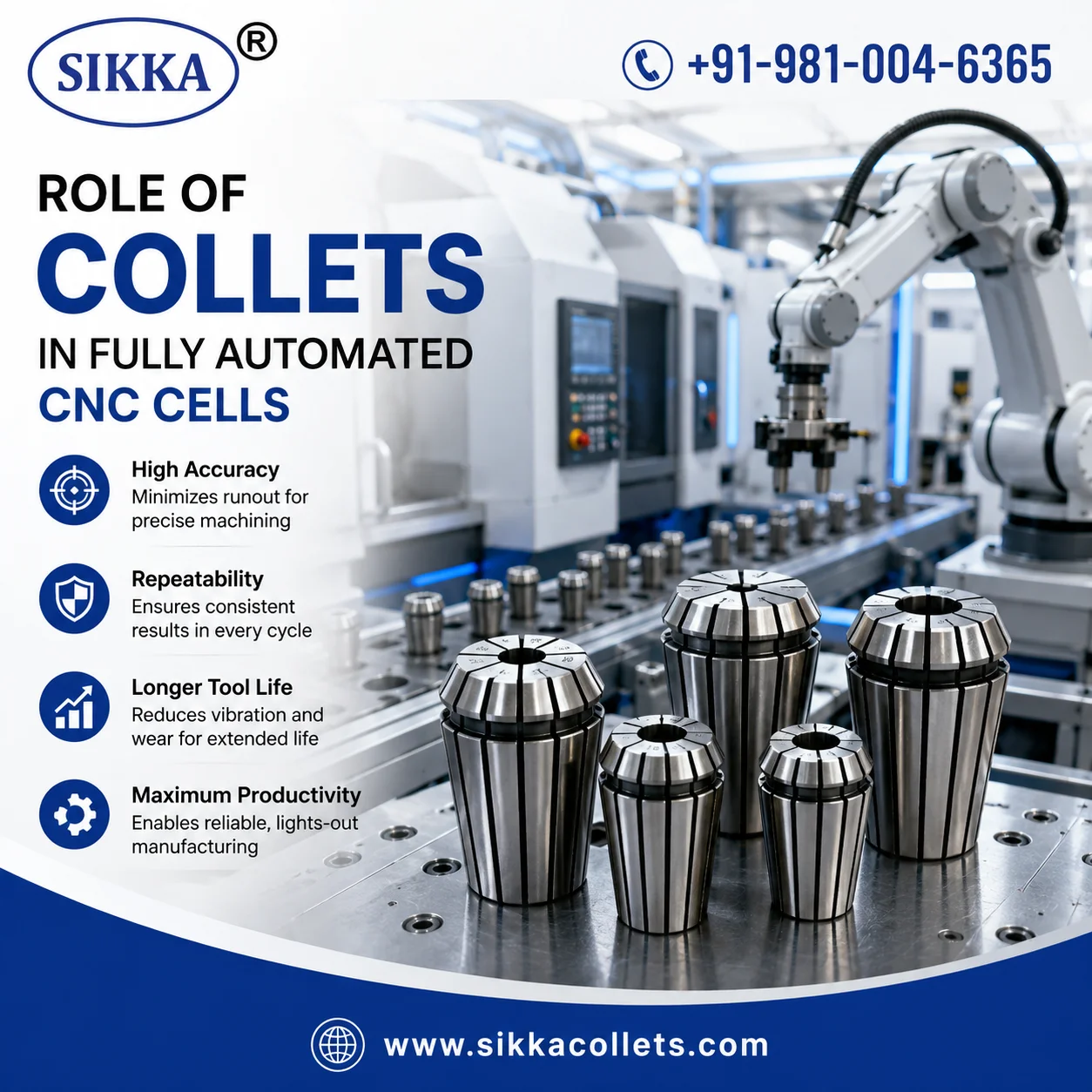
In fully automated CNC cells, consistency matters more than speed. Machines run without constant human supervision. Every cycle must deliver the same result. This is where collets play a critical role.
A collet is not just a tool holding component. It directly controls accuracy, repeatability, and stability. In automated environments, even a small deviation can affect hundreds of parts. That is why the role of collets in fully automated CNC cells becomes essential for reliable production.
Sikka Precision Technologies is a professionally operated company that manufactures high-quality precision collets using advanced-grade steel. The focus remains on maintaining dimensional accuracy, stable clamping, and long service life across demanding machining conditions.
Automation removes manual correction. Machines depend on pre-set parameters. The tool holding system must perform without variation.
Collets provide uniform 360-degree clamping. This ensures the tool stays aligned with the spindle axis. As a result, runout remains controlled across repeated cycles.
In automated CNC cells, this consistency helps maintain tight tolerances. It also reduces the need for rework or inspection delays.
To understand how different systems support machining accuracy, you can explore CNC tool holding systems.
Repeatability in Automated Production
Repeatability is the backbone of automation. A CNC cell may produce thousands of parts in a single run. Each part must match the previous one.
Collets ensure identical clamping force every time the tool is loaded. This eliminates variation between cycles. The cutting tool engages the workpiece in a predictable manner.
Without repeatable clamping, tool wear becomes uneven. Dimensional errors start appearing over long production runs.
Proper collet selection helps avoid such issues. You can review key factors in choosing the right collet for your CNC machine.
Accuracy and Runout Control
Runout directly affects machining quality. Even a small misalignment can change surface finish and dimensional accuracy.
Collets minimize runout by gripping the tool evenly. This improves hole quality, surface finish, and cutting stability.
In automated CNC cells, controlled runout ensures consistent results over long cycles. It also reduces vibration during high-speed operations.
Runout and surface finish are closely connected. A detailed explanation is available here: impact of collet selection on surface finish and tolerance.
Role in Automatic Tool Changing (ATC)
Fully automated CNC cells rely on automatic tool changers. Tools are loaded and unloaded without manual intervention.
Collets must maintain their seating accuracy after every tool change. If the clamping position shifts, machining results will vary.
A stable collet system ensures that each tool returns to the same position. This reduces setup errors and improves cycle reliability.
Collet holders also play a role in this process. You can explore more about collet holders and their function in CNC setups.
Vibration Control and Tool Stability
Vibration is a common issue in long machining cycles. It affects tool life and surface quality.
Collets reduce vibration by providing balanced clamping. The tool remains stable even at high spindle speeds.
This stability becomes more important in automated CNC cells. Machines often run continuously. Any vibration can lead to gradual quality loss.
Stable clamping also supports better chip formation. This improves cutting efficiency and reduces heat generation.
Impact on Tool Life in Automated Environments
Tool life is directly linked to how the tool is held. Uneven clamping causes localized stress on cutting edges.
Collets distribute the load evenly across the tool shank. This reduces wear concentration and extends tool life.
In automated CNC cells, longer tool life means fewer interruptions. Machines can run for extended periods without tool replacement.
This improves overall production efficiency and reduces downtime.
For deeper insights, refer to how collets improve CNC machine productivity.
Types of Collets Used in Automated CNC Cells
Different applications require different collet types. Selection depends on machining operation and accuracy requirements.
ER collets are widely used due to their flexibility. They support milling, drilling, and light turning operations.
Lathe collets are preferred in turning applications. They provide stronger grip and better positional accuracy.
Specialized collets are used in high-precision or high-speed environments.
Productivity Gains in Fully Automated CNC Cells
Productivity in automated environments depends on uninterrupted machining. Machines are expected to run continuously with minimal intervention.
The role of collets in fully automated CNC cells becomes clear when production stability is analyzed. A reliable collet reduces unexpected stoppages. It ensures the tool remains secure throughout long cycles.
Stable clamping improves cutting efficiency. Tools engage smoothly with the material. This reduces cutting resistance and avoids sudden load variation.
As a result, cycle time remains consistent. Output becomes predictable. This is critical in high-volume manufacturing setups.
Collets also reduce the need for frequent tool adjustments. This helps maintain workflow continuity in automated systems.
Collets vs Other Tool Holding Systems in Automation
Different tool holding systems are used in CNC machining. However, not all are equally suited for automation.
Collets provide a balance between accuracy and flexibility. They can handle different tool sizes within a defined range.
Hydraulic holders offer strong damping but are less flexible. Shrink fit holders provide high precision but require additional setup time.
In fully automated CNC cells, quick tool change and repeatability are more important than complex setup processes.
This makes collets a practical choice for automated environments. They support both performance and operational efficiency.
A detailed comparison can be explored here: collets vs hydraulic chucks vs shrink fit holders.
Integration with Smart Manufacturing Systems
Modern CNC cells are part of connected manufacturing systems. Machines are monitored using sensors and software.
Collets influence the data generated by these systems. Runout variation, vibration, and tool stability all affect machining signals.
A worn or damaged collet can introduce inconsistency. This can trigger false alerts or lead to incorrect process adjustments.
Consistent collet performance helps maintain reliable data. This supports better decision-making in automated production environments.
Smart monitoring becomes more effective when the tool holding system performs predictably.
Maintenance Practices in Automated CNC Cells
Maintenance plays a direct role in performance. Even high-quality collets require regular inspection.
In automated CNC cells, maintenance intervals should be planned. Machines often run for extended hours without stopping.
Dust, chips, and oil residue can affect clamping accuracy. Cleaning the collet and holder ensures proper seating.
Regular inspection helps identify wear before it impacts production. Replacing worn collets prevents sudden failures.
Proper handling also matters. Incorrect installation can damage the collet or reduce its gripping efficiency.
Best practices are explained in detail here: collet handling, cleaning, and replacement.
Common Issues in Automated CNC Cells Due to Poor Collets
Problems in automated machining often trace back to tool holding issues. Collets are a key part of this system.
One common issue is tool slippage. This happens when clamping force is not uniform. It leads to dimensional errors.
Another issue is increased runout. This affects surface finish and accuracy. Over time, it can cause part rejection.
Vibration is also linked to poor collet condition. It reduces tool life and affects machining stability.
In automated CNC cells, such issues can go unnoticed for several cycles. This increases scrap and reduces efficiency.
Common problems and solutions are discussed here: common collet problems in CNC machines.
Applications Across Industries
The role of collets in fully automated CNC cells is visible across multiple industries.
In aerospace manufacturing, precision is critical. Collets help maintain tight tolerances during complex machining operations.
In automotive production, consistency is required in mass production. Collets support repeatable machining across large batches.
Medical component manufacturing also relies on high accuracy. Small deviations are not acceptable.
Each of these industries depends on stable and reliable tool holding systems.
Explore industry-specific applications here: collets in aerospace, automotive, and medical manufacturing.
Conclusion
Fully automated CNC cells depend on consistency, accuracy, and stability. The tool holding system directly affects all three.
Collets ensure uniform clamping, controlled runout, and repeatable performance. These factors are essential for automated machining.
They support long production cycles without frequent intervention. This helps maintain productivity and reduces process variation.
The role of collets in fully automated CNC cells goes beyond basic tool holding. It directly influences machining quality and operational efficiency.
Choosing the right collet and maintaining it properly ensures stable performance in automated environments.