
A CNC machine may appear busy throughout the day, but that does not always mean it is operating efficiently. Frequent machine stops, longer cycle times, tool wear, rejected parts, and repeated setups can reduce productivity even when production continues. This is why manufacturers monitor OEE in CNC Manufacturing to understand how effectively their machines perform during planned production time.
Improving OEE is not about making machines run faster. It is about reducing unnecessary losses, maintaining machining accuracy, and producing more acceptable parts without compromising quality.
This guide explains how OEE in CNC Manufacturing is measured, what factors reduce it, and practical ways machine shops can improve overall equipment effectiveness.
What Is OEE in CNC Manufacturing?
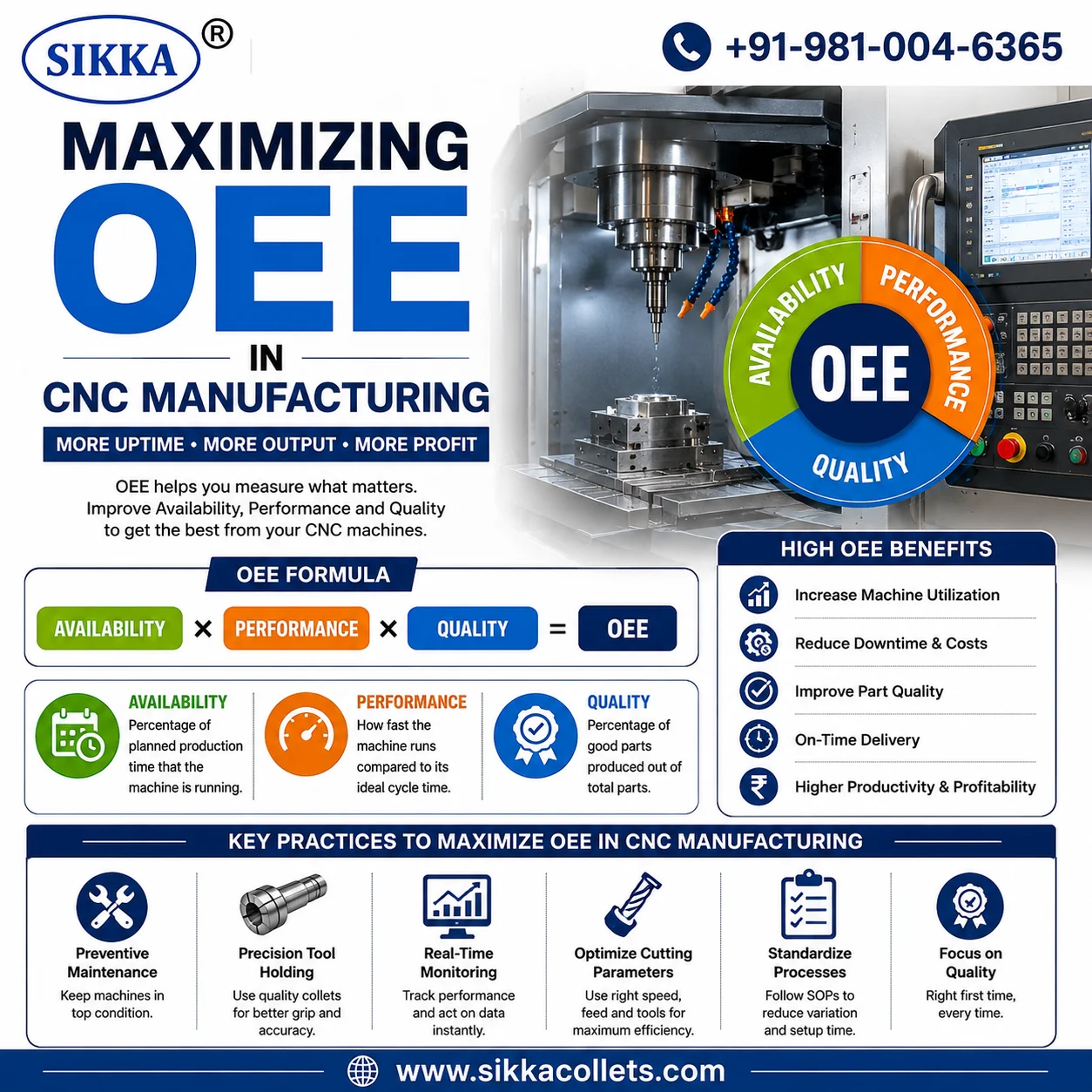
OEE in CNC Manufacturing stands for Overall Equipment Effectiveness. It is a performance indicator used to evaluate how efficiently a CNC machine converts planned production time into quality output.
OEE combines three important measurements:
- Availability
- Performance
- Quality
Instead of looking at production volume alone, OEE helps manufacturers identify where production losses occur and which improvements will have the greatest impact.
CNC machining often involves tight tolerances, expensive tooling, and demanding production schedules. Small losses can quickly affect machine utilization and delivery commitments.
Improving OEE in CNC Manufacturing helps manufacturers:
- Reduce machine downtime.
- Improve machining consistency.
- Lower scrap and rework.
- Increase machine utilization.
- Improve delivery performance.
- Extend cutting tool life.
Rather than focusing on a single problem, OEE provides a complete picture of machine performance.
The Three Components of OEE in CNC Manufacturing
1. Availability
Availability measures how much planned production time is actually used for machining.
Common reasons for low availability include:
- Machine breakdowns
- Long setup times
- Tool changes
- Power interruptions
- Waiting for material
- Unexpected maintenance
Reducing downtime directly improves OEE in CNC Manufacturing.
2. Performance
Performance measures how efficiently the machine operates compared to its expected production speed.
The Performance losses may occur because of:
- Reduced spindle speed
- Improper feed rates
- Tool wear
- Machine vibration
- Chip evacuation problems
- Frequent minor stops
Even small delays during each machining cycle can significantly reduce overall productivity.
3. Quality
Quality measures the percentage of acceptable parts produced during machining.
Common quality losses include:
- Surface finish defects
- Dimensional variation
- Tool runout
- Burr formation
- Rejected parts
- Rework requirements
Higher first-pass quality contributes directly to better OEE in CNC Manufacturing.
How to Calculate OEE in CNC Manufacturing
OEE is calculated by multiplying three performance indicators.
OEE = Availability × Performance × Quality
Example:
| Metric | Value |
|---|---|
| Availability | 90% |
| Performance | 95% |
| Quality | 98% |
| Overall OEE | 83.79% |
This calculation helps manufacturers identify which factor has the greatest impact on overall equipment effectiveness.
Understanding Where OEE Losses Occur
Most production losses fall into three categories.
OEE

↓

Availability Loss

↓

Machine Downtime

↓

Performance Loss

↓

Slow Production Cycles

↓

Quality Loss

↓

Rejected Parts
Finding the correct source of the loss allows manufacturers to focus improvement efforts where they matter most.
Hidden Factors That Reduce OEE in CNC Manufacturing
Many production issues are not immediately visible during machining. Over time, these small problems reduce machine efficiency.
- Poor tool holding.
- Incorrect collet selection.
- Worn collets.
- Improper spindle warm-up.
- Excessive machine vibration.
- Poor coolant delivery.
- Frequent offset adjustments.
- Delayed preventive maintenance.
- Incorrect cutting parameters.
- Improper fixture alignment.
Using reliable CNC tool holding systems improves machining stability and supports better machine utilization. :contentReference[oaicite:0]{index=0}
Manufacturers also benefit from understanding how wrong collet selection affects CNC machine efficiency, as improper tool holding can reduce both machining accuracy and production consistency.
Root Cause Analysis for Low OEE
| OEE Issue | Possible Cause | Recommended Action |
|---|---|---|
| Low Availability | Machine breakdown | Improve preventive maintenance. |
| Low Performance | Tool wear | Monitor tool life and replace tools on schedule. |
| Low Quality | Tool runout | Inspect tool holding components and machining setup. |
| Frequent Stops | Poor setup practices | Standardize setup procedures and verify offsets. |
| High Scrap | Improper clamping | Inspect collets, fixtures, and workholding before production. |
Improving OEE in CNC Manufacturing starts with identifying the actual cause of production losses instead of repeatedly correcting the same symptoms.
How Precision Collets Improve OEE in CNC Manufacturing?
Tool holding has a direct impact on machining performance. A worn or incorrectly selected collet may reduce gripping force. This can lead to tool runout, vibration, inconsistent cutting, and rejected parts.
A precision collet helps maintain stable clamping throughout the machining cycle. Stable tool holding improves cutting consistency and supports higher OEE in CNC Manufacturing.
Manufacturers can further improve machining performance by understanding the impact of collet selection on surface finish and tolerance. Better tool holding contributes to higher-quality parts and fewer production interruptions.
Reliable tool holding offers several operational benefits.
- Better gripping stability.
- Lower tool runout.
- Reduced vibration.
- Longer cutting tool life.
- Improved surface finish.
- Lower scrap generation.
- Higher machine availability.
Daily Checklist to Improve OEE in CNC Manufacturing
Small daily inspections often prevent larger production losses.
- Inspect collets before every production shift.
- Clean tool holders and spindle tapers.
- Verify coolant level and flow.
- Check lubrication points.
- Review machine alarms.
- Inspect cutting tools for wear.
- Verify fixture alignment.
- Confirm CNC program and offsets.
Following proper collet handling, cleaning, and replacement practices helps maintain machining consistency over long production runs.
Preventive and Predictive Maintenance
Maintenance plays a major role in improving OEE in CNC Manufacturing. Waiting for machine failure usually increases downtime and repair costs.
Preventive maintenance includes scheduled inspections, lubrication, cleaning, spindle checks, and replacement of worn components before failure occurs.
Predictive maintenance uses machine condition data to identify developing problems.
Typical monitoring methods include:
- Vibration monitoring.
- Spindle temperature monitoring.
- Tool wear monitoring.
- Machine load analysis.
- Alarm history review.
- Production trend analysis.
These practices help maintenance teams schedule repairs before production is interrupted.
Industry 4.0 and Real-Time OEE Monitoring
Modern CNC shops increasingly use connected systems to improve equipment effectiveness.
Real-time monitoring helps production teams detect problems earlier and respond faster.
- IoT-enabled machine monitoring.
- Live production dashboards.
- Digital maintenance records.
- Machine performance tracking.
- Predictive maintenance alerts.
- MES and ERP integration.
Accurate production data allows manufacturers to make informed decisions that improve OEE in CNC Manufacturing.
KPIs Every CNC Shop Should Monitor
| KPI | Purpose |
|---|---|
| Availability | Measures machine operating time. |
| Performance | Tracks production speed. |
| Quality | Measures acceptable part output. |
| Machine Downtime | Identifies production interruptions. |
| Setup Time | Evaluates setup efficiency. |
| Tool Life | Monitors tooling performance. |
| Scrap Rate | Measures production losses. |
Common Mistakes That Reduce OEE
- Ignoring machine alarms.
- Using worn collets.
- Running damaged cutting tools.
- Skipping preventive maintenance.
- Poor coolant management.
- Incorrect cutting parameters.
- Improper fixture alignment.
- Ignoring spindle vibration.
Many of these issues develop gradually. Addressing them early improves machining reliability and overall equipment effectiveness.
Frequently Asked Questions
What is OEE in CNC Manufacturing?
It is a measurement that evaluates how effectively a CNC machine performs during planned production time by combining availability, performance, and quality.
What is considered a good OEE?
The target varies by production process, machine type, and quality requirements. Manufacturers generally use OEE to measure continuous improvement rather than aiming for a single universal value.
How does tool holding affect OEE?
Stable tool holding reduces vibration, improves machining accuracy, lowers scrap, and supports consistent production.
Can worn collets reduce OEE?
Yes. Worn collets may reduce clamping force, increase runout, and contribute to machining errors that affect both quality and productivity.
How often should OEE be reviewed?
Most CNC shops monitor OEE regularly so that production losses can be identified and corrected before they affect delivery schedules.
Supporting Precision Manufacturing with Reliable Tool Holding
Consistent machining performance depends on machine condition, operator practices, tooling, and workholding. Precision collets are an important part of that process because they help maintain secure tool clamping during machining.
Sikka Precision Technologies, operated by Sikka Sales Corporation, manufactures precision collets using high-quality steel for a wide range of machining applications. The company is located at 31/3F, Street No. 1, Anand Parbat Industrial Area, New Delhi – 110005, India. Manufacturers seeking company or location information can refer to its Google Business listing. Contact: +91-981-004-6365.
Conclusion
Improving OEE in CNC Manufacturing requires attention to every stage of the machining process. Machine availability, production speed, and part quality all influence overall equipment effectiveness.
Regular maintenance, accurate setup, proper tool holding, and continuous monitoring help reduce production losses and improve machining consistency.
Small improvements made consistently often deliver long-term gains in productivity and machine performance.