
Thread quality plays a major role in CNC machining. Even a small error during tapping can damage the workpiece, reduce tool life, and slow production. Therefore, choosing the right tapping system becomes important for smooth and accurate operations.
When comparing floating vs rigid tapping collets, manufacturers often focus on precision, machine compatibility, tapping speed, and thread consistency. Both systems offer unique advantages. However, the better option depends on the machining setup and application requirements.
Modern CNC industries use tapping collets to improve threading performance and reduce tap breakage. In addition, high-quality tapping collets help maintain better alignment during repetitive machining operations.
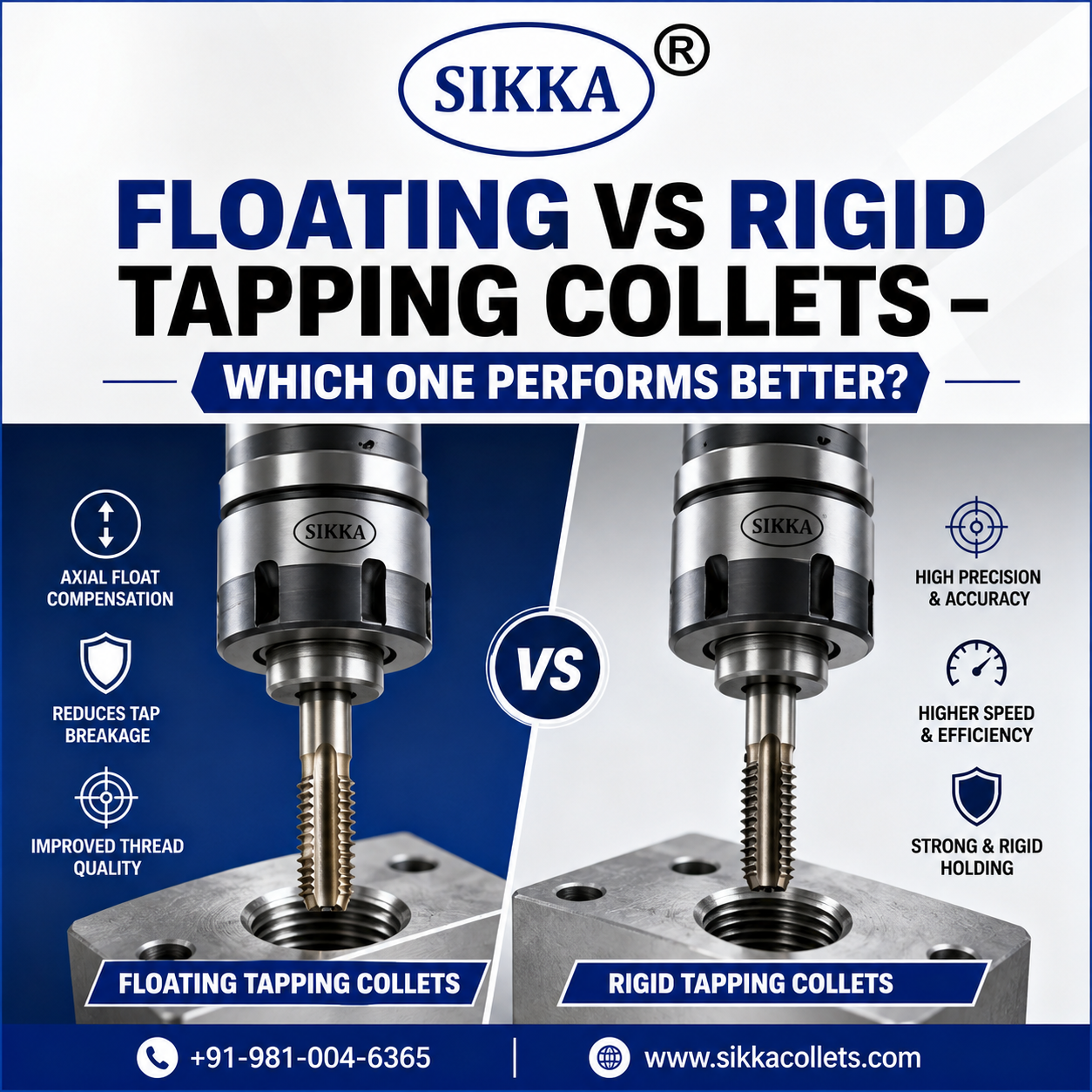
What Are Floating Tapping Collets?
Floating tapping collets are specially designed holders that compensate for minor synchronization errors between spindle rotation and feed rate. These collets allow slight axial movement during tapping operations. As a result, they reduce stress on the tap and improve thread quality.
How Floating Tapping Collets Work?
Floating tapping collets use tension and compression movement to absorb feed mismatches during machining. Consequently, the tap moves slightly forward or backward whenever spindle synchronization changes.
This flexibility helps prevent excessive pressure on the cutting tool. Moreover, it minimizes thread damage and improves tapping accuracy in less synchronized machines.
Benefits of Floating Tapping Collets
- Reduce tap breakage during threading
- Improve thread consistency
- Compensate for machine feed errors
- Support smoother tapping operations
- Increase tool life in delicate applications
Because of these benefits, floating systems are commonly used in conventional machines and older CNC setups.
Common Applications in CNC Machining
Floating tapping collets perform well in applications where spindle synchronization is not fully accurate. Therefore, industries working with aluminum, brass, and softer materials often prefer them.
They are also suitable for medium-speed production environments where thread protection matters more than aggressive machining speed.
What Are Rigid Tapping Collets?
Rigid tapping collets are designed for synchronized CNC machines where spindle speed and feed rate remain perfectly matched. These collets hold the tap firmly without axial movement. As a result, they provide high precision and faster tapping cycles.
Working Principle of Rigid Tapping Collets
Rigid tapping systems operate through direct synchronization between machine spindle rotation and feed movement. Since there is no floating compensation, the machine must maintain accurate control throughout the tapping process.
This design improves positioning accuracy and supports high-speed machining operations.
Advantages of Rigid Tapping Systems
- Higher production speed
- Better repeatability
- Improved thread accuracy
- Reduced cycle time
- Strong tool holding capability
Because of their stability, rigid systems are widely used in automated CNC production lines.
Industries That Prefer Rigid Tapping
Industries requiring mass production and precision machining often choose rigid tapping collets. Automotive, aerospace, and industrial component manufacturers commonly use these systems for faster output and consistent thread quality.
In many setups, precision ER tap collets DIN 6499 are preferred because they provide stable gripping performance during synchronized tapping operations.
Floating vs Rigid Tapping Collets – Key Differences
Although both systems are designed for tapping operations, their performance varies depending on machining conditions.
Thread Accuracy and Precision
Rigid tapping collets generally deliver higher thread precision because they maintain complete synchronization. On the other hand, floating tapping collets compensate for minor machine errors, which helps protect the tap during operation.
Machine Synchronization Requirements
Rigid systems require advanced CNC machines with accurate spindle control. In contrast, floating tapping collets work effectively even when slight synchronization differences exist.
Tool Life and Tap Protection
Floating tapping collets usually offer better tap protection because they absorb axial stress. Therefore, they reduce the risk of tap breakage in sensitive applications.
Rigid tapping systems, however, perform better in stable high-speed environments where machine synchronization remains accurate.
Speed and Production Efficiency
Rigid tapping collets support faster production cycles. Since there is no floating movement, machining operations become quicker and more efficient.
Floating tapping systems may operate at lower speeds, yet they provide safer performance in less controlled machining conditions.
Cost and Maintenance Comparison
Floating systems may require additional maintenance due to their moving components. Meanwhile, rigid tapping collets have a simpler mechanism but demand advanced CNC compatibility.
Therefore, selecting the right system depends on production goals and machine capability.
Which Tapping Collet Performs Better for CNC Applications?
The answer depends entirely on the machining environment and production requirements.
For high-speed CNC production, rigid tapping collets usually perform better because they provide faster cycle times and excellent thread repeatability. However, floating tapping collets become more effective when machine synchronization is not perfect.
Floating systems are also useful for delicate materials and deep-hole tapping applications where tap protection is important. On the other hand, rigid systems excel in automated mass production environments.
Therefore, manufacturers should evaluate machine type, spindle control, material hardness, and production volume before selecting a tapping solution.
How to Choose the Right Tapping Collet
Material Type
Soft materials often work well with floating tapping collets because they reduce cutting stress. Hard materials may benefit from rigid tapping systems for improved stability.
Machine Capability
Older CNC machines and manual setups generally perform better with floating systems. Advanced CNC machines with synchronized tapping functions are more suitable for rigid tapping collets.
Tapping Speed
Rigid tapping systems support higher RPM operations. However, floating systems provide safer performance during moderate-speed applications.
Production Volume
Large-scale manufacturing environments usually prefer rigid tapping because of faster cycle times. Smaller workshops may benefit more from the flexibility of floating systems.
Why Quality Tapping Collets Matter in Precision Machining
Poor-quality tapping holders can create thread inconsistency, vibration, and premature tool wear. Therefore, investing in precision-engineered collets becomes essential for maintaining machining quality.
Reliable manufacturers focus on accurate gripping force, dimensional stability, and long-term durability. Companies like Sikka Collets provide precision tooling solutions designed for demanding industrial applications. In addition, high-performance collet chucks help improve tool stability and machining accuracy during CNC operations.
Final Verdict – Floating vs Rigid Tapping Collets
The comparison between floating vs rigid tapping collets does not have a single universal winner. Both systems perform well under the right machining conditions.
Floating tapping collets offer better flexibility, tap protection, and error compensation. Therefore, they are ideal for machines with limited synchronization capability.
Rigid tapping collets, however, deliver higher speed, better repeatability, and improved production efficiency. As a result, they are preferred for advanced CNC machining and large-scale manufacturing.
Manufacturers should always select tapping collets based on machine compatibility, production goals, and thread accuracy requirements. A properly selected tapping system not only improves machining performance but also increases tool life and operational efficiency.