
A Small Mistake That Cost an Entire Batch
Rohit still remembers the sound.
It wasn’t loud. It wasn’t dramatic. But inside his CNC shop, that slight vibration was enough to ruin 200 precision components in one shift. The surface finish was rough. The dimensions were off. And worst of all, the cutting tool had slipped mid-operation.
The problem wasn’t the machine. It wasn’t the program. It wasn’t even the operator.
It was the wrong ER collet.
If you’ve ever faced tool slippage, chatter marks, poor surface finish, or unexplained runout, this story might feel familiar. Let’s break down what actually happens when the wrong ER collet is used — and how to avoid expensive mistakes.
What Is an ER Collet and Why Does It Matter?
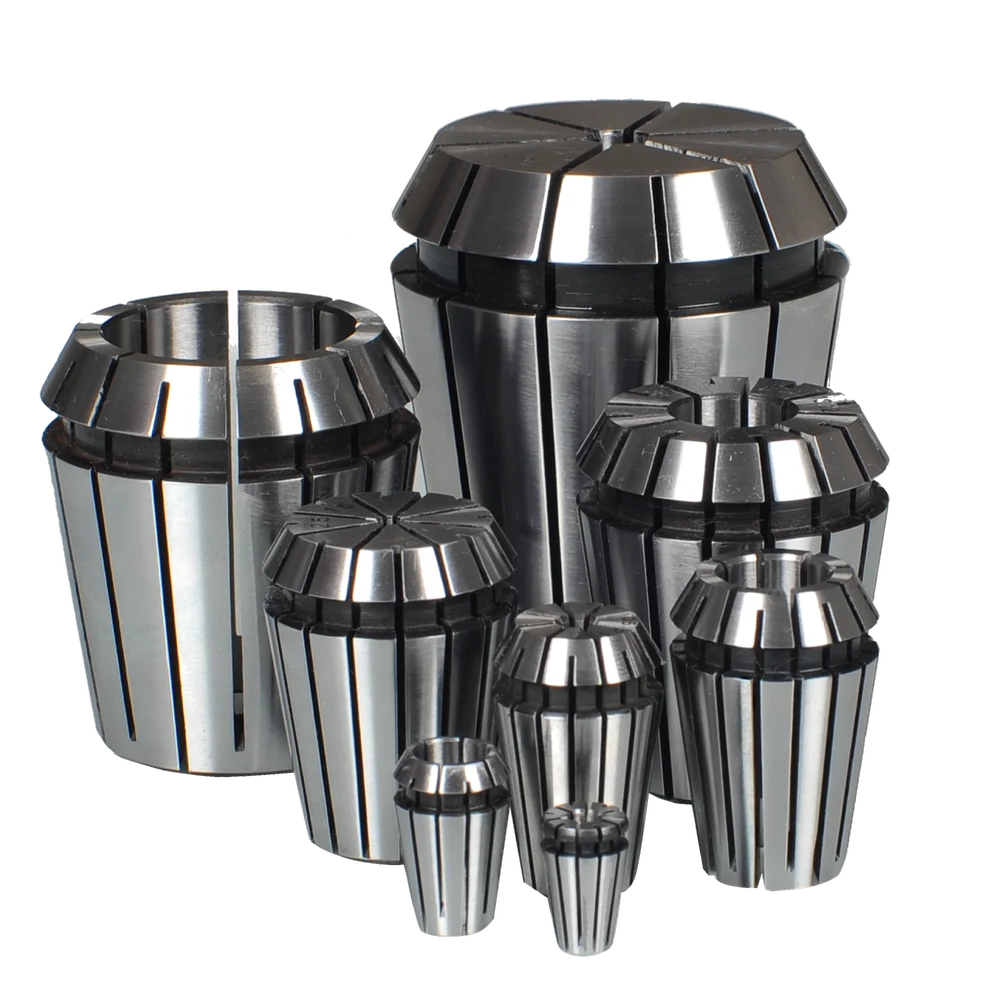
An ER collet is a precision clamping device used to hold cutting tools inside CNC machines, milling machines, and drilling setups. It fits inside specialized collet chucks that compress the collet evenly around the tool shank.
High-quality ER collets are designed to provide:
- Uniform 360-degree clamping
- Excellent concentricity
- Strong grip with minimal distortion
- High repeatability
But when the size is wrong — even slightly — performance drops instantly.
The Real Problem: Choosing the Wrong Size
Story Continues: The 1 mm Assumption
Rohit’s team was machining stainless steel shafts. The tool shank was 12 mm. The operator used an ER32 collet with a 11–12 mm clamping range, assuming “it will adjust.”
Technically, ER collets have a collapse range. But here’s what many overlook:
- Maximum gripping accuracy occurs at nominal size
- Clamping at extreme ends reduces grip strength
- Over-collapsing causes uneven pressure
This leads to tool slippage.
What Is Bit Slip and Why Does It Happen?
Bit slip happens when the cutting tool moves inside the collet during machining.
Common Causes:
- Incorrect collet size
- Worn-out collet
- Contaminated clamping surfaces
- Improper torque during tightening
- Low-quality material or heat treatment
When the tool slips:
- Cutting depth changes
- Surface finish deteriorates
- Tool breakage risk increases
- Dimensional accuracy is lost
In Rohit’s case, the 12 mm tool slipped by 0.3 mm during a heavy cut. That small movement ruined the entire tolerance band.
Understanding Runout: The Silent Accuracy Killer
Runout refers to the deviation of a rotating tool from its true centerline.
Even 10–15 microns of extra runout can cause:
- Uneven tool wear
- Chatter vibration
- Poor surface finish
- Reduced spindle life
Incorrect collet sizing increases runout because the tool isn’t centered perfectly. The collet compresses unevenly, especially if operating at its maximum collapse range.
High-precision systems follow strict dimensional norms such as those found in Din collets standards, ensuring consistent concentricity and predictable performance.
How to Choose the Correct ER Collet Size?
Let’s simplify this.
Step 1: Measure the Tool Shank Precisely
Never assume a tool is exactly 12 mm or 10 mm. Use a calibrated micrometer.
Step 2: Match Nominal Size
If your tool shank is 12 mm, use a 12 mm collet — not 11–12 mm unless absolutely necessary.
Step 3: Avoid Extreme Collapse
ER collets typically have a 1 mm collapse range, but best grip is achieved in the center of that range.
Step 4: Check Torque Specifications
Under-tightening reduces grip. Over-tightening damages slots and reduces life.
Step 5: Inspect Regularly
Collets are consumables. Micro-cracks or wear affect performance long before visible damage appears.
Why Collet Quality Makes a Massive Difference?
Rohit replaced his low-cost imported collets with precision-ground ones from a reputed Collets Manufacturer.
The difference?
- Improved grip strength
- Lower runout readings
- Better surface finish
- Longer tool life
Quality collets use hardened alloy steel, controlled heat treatment, and precision slot grinding. Poor-quality collets often fail in high-speed CNC operations due to inconsistent metallurgy.
Comparing ER with Other Collet Systems
Although this article focuses on ER systems, workshops sometimes confuse them with systems like 5C collets used mainly in lathes and grinders.
The difference is application:
- ER collets are primarily tool-holding systems.
- 5C systems are typically work-holding systems.
Choosing the wrong system for the application can also cause accuracy issues.
Hidden Signs You Are Using the Wrong ER Collet
Watch for these warning signs:
- Tool gradually pulling out
- Unusual vibration during heavy cuts
- Shiny marks on tool shank
- Repeated dimensional deviation
- Inconsistent bore finish
If you notice two or more of these symptoms, inspect your collet first — not the spindle.
The Technical Science Behind Clamping Force
An ER collet works through axial compression. When the collet nut tightens, it pushes the collet into a tapered seat inside the chuck.
This causes:
- Radial inward pressure
- Uniform clamping
- Self-centering effect
But this mechanism works perfectly only when:
- The taper angles are precise
- The collet slots are evenly ground
- The chuck taper is undamaged
- The size selection is correct
If any one factor is compromised, performance drops.
How Sikka Collets Builds Trust in Precision Engineering?
Precision machining demands trust — not just in machines, but in tooling.
Sikka Collets has built its reputation by focusing on engineering discipline rather than mass shortcuts. Each collet undergoes controlled heat treatment, dimensional inspection, and concentricity testing before dispatch.
What sets them apart is their application-focused approach. Instead of just selling components, they understand the production challenges faced by Indian manufacturers — from automotive units to precision tool rooms.
Their facility is located at:
31/3F, Gali Number 1, Anand Parbat Industrial Area, Anand Parbat, Delhi, 110007 Google Maps: https://maps.app.goo.gl/jyTsiV57mJWgsh3k6
Contact: 09810046365
For manufacturers struggling with tool slip or runout, consulting a knowledgeable supplier often solves problems faster than machine recalibration.
Final Lesson from Rohit’s Workshop
After correcting the collet size and upgrading to higher-quality tooling, Rohit’s shop achieved:
- 30% better tool life
- Reduced rejection rate
- Stable dimensional control
- Smoother surface finish
The cost of the correct ER collet was insignificant compared to the cost of scrap and downtime.
Final Thoughts: Precision Starts with the Smallest Component
In machining, the smallest parts often control the biggest outcomes.
Using the wrong ER collet can cause:
- Bit slip
- Increased runout
- Poor finish
- Tool damage
- Production losses
The solution is simple: Choose the correct size. Follow proper torque guidelines. Inspect regularly. Invest in quality. Because in precision engineering, tolerance is everything — and the collet sits at the center of it all.