
Computer Numerical Control (CNC) machines have completely transformed modern manufacturing. From automotive parts to aerospace components and medical tools, CNC technology ensures high precision, repeatability, and efficiency.
If you are a student, workshop owner, production manager, or someone planning to invest in machining technology, this guide will clearly explain the 5 common types of CNC machines, how they work, where they are used, and how to choose the right one for your application.
This blog is written to answer real user questions with clarity, technical accuracy, and practical industry insights.
1. CNC Lathe Machine
What Is a CNC Lathe?
A CNC lathe machine rotates the workpiece while a stationary cutting tool shapes it. It is mainly used for cylindrical or round components.
How It Works
- The material (bar stock) is clamped in a chuck or collet.
- The spindle rotates at high speed.
- The cutting tool moves along programmed axes.
- Material is removed to create the desired shape.
Common Applications
- Shafts
- Bushings
- Fasteners
- Hydraulic fittings
- Automotive components
CNC lathes are widely used in high-volume production because they offer speed and consistent dimensional accuracy.
In many precision turning setups, standardized holding systems such as 5C collets are preferred because they provide excellent concentricity and quick material changeover.
Advantages
- Ideal for round components
- High production speed
- Excellent surface finish
- Automation-friendly
2. CNC Milling Machine
What Is a CNC Milling Machine?
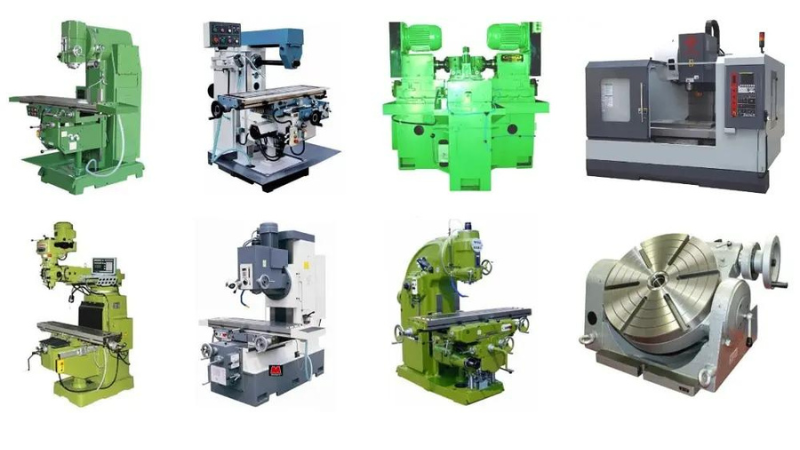
Unlike a lathe, in CNC milling the cutting tool rotates while the workpiece remains stationary or moves along programmed axes. Milling machines can operate in 3-axis, 4-axis, or 5-axis configurations.
How It Works
- The cutting tool rotates at high RPM.
- The table moves in X, Y, and Z directions.
- Complex shapes are created through controlled toolpaths.
Common Applications
- Engine blocks
- Mold making
- Aerospace brackets
- Tooling components
CNC milling is extremely versatile and can create flat surfaces, slots, pockets, and complex contours.
Advantages
- Suitable for complex geometries
- High precision and repeatability
- Multi-axis capabilities
- Ideal for both prototyping and production
3. CNC Drilling Machine
What Is a CNC Drilling Machine?
A CNC drilling machine is specifically designed to create precise holes in materials. While drilling operations can also be performed on milling machines, dedicated CNC drilling systems are used in mass production environments.
How It Works
- The drill bit rotates.
- The tool feeds vertically into the material.
- Depth and diameter are controlled by programmed commands.
Common Applications
- PCB manufacturing
- Structural steel fabrication
- Automotive assemblies
- Aerospace panels
Advantages
- High hole-position accuracy
- Fast cycle times
- Consistent depth control
- Reduced manual error
For accurate drilling tool holding, systems like Collet chucks are commonly used because they ensure rigid clamping and minimize runout.
4. CNC Grinding Machine
What Is a CNC Grinding Machine?
CNC grinding machines are used for high-precision surface finishing. Instead of cutting tools, they use abrasive grinding wheels to remove small amounts of material.
How It Works
- The grinding wheel rotates at high speed.
- The workpiece is positioned precisely.
- Material is removed in microns for superior finish.
Common Applications
- Bearing components
- Precision shafts
- Tool sharpening
- Die and mold finishing
Advantages
- Extremely tight tolerances
- Superior surface finish
- Ideal for hardened materials
- Micron-level accuracy
Grinding machines are essential in industries where dimensional accuracy is critical, such as aerospace and medical device manufacturing.
5. CNC Plasma Cutting Machine
What Is a CNC Plasma Cutter?
A CNC plasma cutting machine uses high-temperature plasma to cut conductive materials such as steel, aluminum, and brass.
How It Works
- Compressed gas is ionized into plasma.
- Plasma arc melts the metal.
- CNC controls guide the cutting path.
Common Applications
- Sheet metal fabrication
- Structural steel cutting
- Industrial signage
- Heavy machinery parts
Advantages
- Fast cutting speed
- Suitable for thick materials
- Cost-effective for large sheets
- Ideal for industrial fabrication
How to Choose the Right CNC Machine?
Selecting the right CNC machine depends on:
- Type of material
- Component complexity
- Production volume
- Tolerance requirements
- Budget and automation goals
For cylindrical components, CNC lathes are ideal. For complex shapes, CNC milling machines are better. For high-precision finishing, grinding machines are necessary. For sheet cutting, plasma systems are preferred.
Understanding your production objective is the first step toward making a smart investment.
The Importance of Precision Tooling in CNC Operations
No CNC machine can deliver accurate results without proper tooling and clamping systems. Precision workholding plays a major role in maintaining repeatability and dimensional stability.
Choosing the right tooling partner matters. A trusted Collets Manufacturer ensures:
- Accurate bore tolerances
- Durable alloy steel construction
- Controlled heat treatment
- Long tool life
- Reliable gripping force
High-quality collets reduce vibration, improve surface finish, and extend spindle life.
Why Sikka Collets Is a Reliable Name in CNC Tooling?
Sikka Collets has built a strong reputation in the precision tooling industry by focusing on engineering accuracy and manufacturing consistency. Their product range supports a wide variety of CNC machines across industries such as automotive, electrical components, aerospace parts, and general engineering manufacturing.
What makes them stand out:
- Advanced machining infrastructure
- Strict inspection standards
- Consistent dimensional accuracy
- Customized solutions for industrial needs
- Focus on long-term reliability
Their expertise helps manufacturers achieve stable production with minimal downtime and improved machining performance.
Address: 31/3F, Gali Number 1, Anand Parbat Industrial Area, Anand Parbat, Delhi, 110007 https://maps.app.goo.gl/jyTsiV57mJWgsh3k6
Contact: 09810046365
Final Thoughts
The five most common types of CNC machines are:
- CNC Lathe Machine
- CNC Milling Machine
- CNC Drilling Machine
- CNC Grinding Machine
- CNC Plasma Cutting Machine
Each machine serves a specific purpose in manufacturing. The right choice depends on your production needs, material type, and required accuracy.
Understanding these machines not only helps in making better purchase decisions but also improves operational efficiency and long-term productivity. Modern manufacturing depends on precision, automation, and reliable tooling. When machines and workholding systems work together perfectly, the result is consistent quality and reduced operational cost.