
Precision is one of the most important requirements in CNC machining. Even a small mistake in tool holding can affect part quality, machining accuracy, and production efficiency. One of the most overlooked causes of machining defects is improper tool clamping.
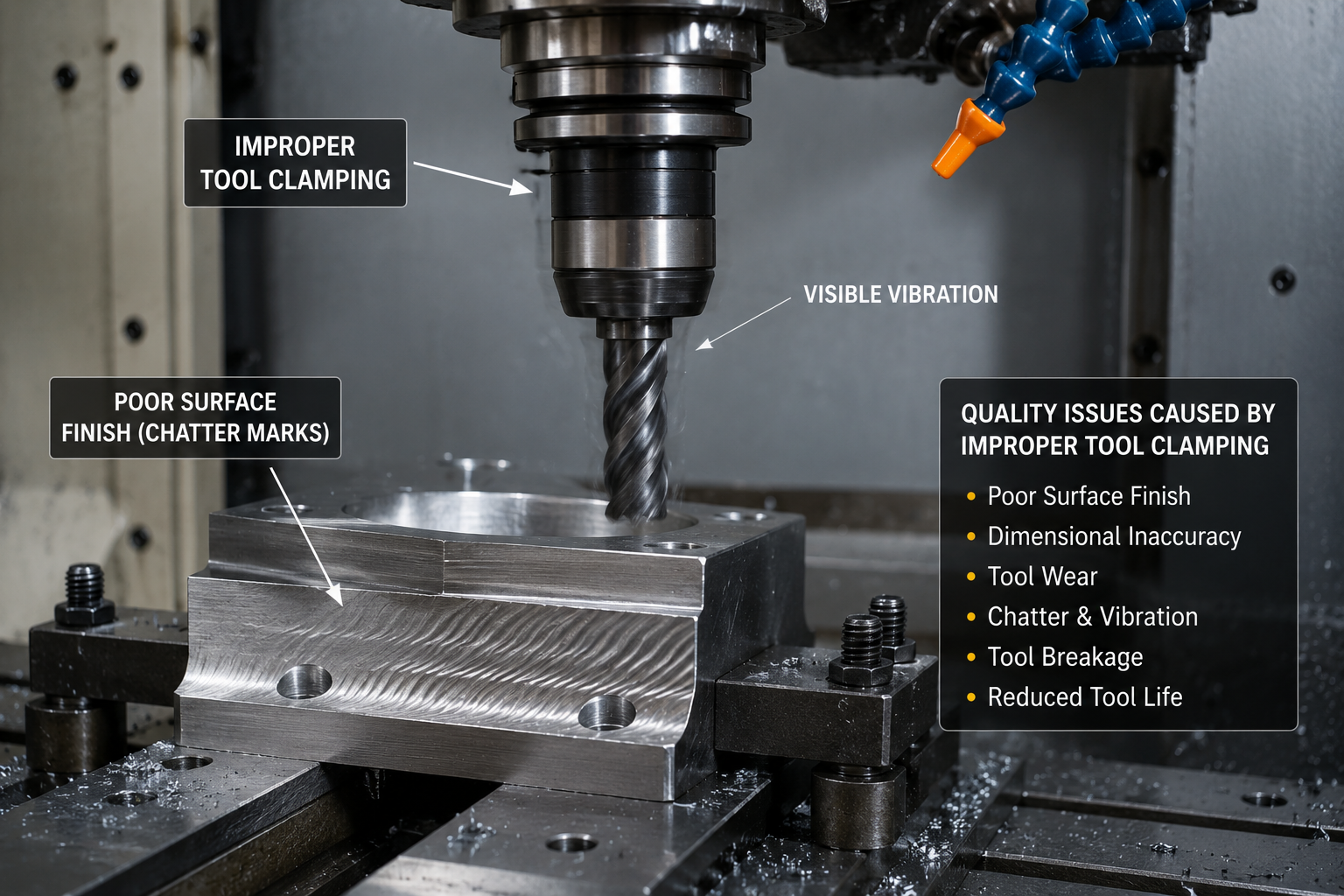
Improper tool clamping occurs when a cutting tool is not held securely inside the collet, chuck, or tool holder. This can lead to tool movement, vibration, runout, and inconsistent machining results. Understanding the common quality issues linked to improper tool clamping can help manufacturers improve productivity, reduce scrap, and extend tool life.
Proper Tool Clamping in CNC Machining
The clamping system connects the cutting tool to the machine spindle. It must provide sufficient gripping force while maintaining concentricity and stability.
High-quality ER collets, tool holders, and collet chucks play a critical role in maintaining machining accuracy. When clamping force is compromised, quality issues become unavoidable.
1. Excessive Tool Runout
One of the most common quality issues linked to improper tool clamping is excessive tool runout. Runout occurs when the cutting tool does not rotate perfectly on its center axis.
Poor clamping can cause the tool to sit off-center inside the collet. As a result, one cutting edge removes more material than the others.
Effects of excessive runout:
- Poor dimensional accuracy
- Uneven tool wear
- Reduced tool life
- Inconsistent machining performance
Using precision CNC tool holding systems helps minimize runout and maintain machining consistency.
2. Poor Surface Finish
Poor surface finish is another common quality issue linked to improper tool clamping. When the tool is not securely held, micro-movements occur during machining.
These movements create visible marks, rough surfaces, and inconsistent finishes on the workpiece.
Industries such as aerospace, medical, and automotive manufacturing require smooth surface finishes. Even minor imperfections can lead to product rejection.
You can learn more about the relationship between clamping and surface quality in our guide on surface finish and tolerance.
3. Dimensional Inaccuracy
Dimensional accuracy is essential for every machined component. Improper tool clamping can cause the cutting tool to shift during machining operations.
This movement often results in:
- Incorrect hole diameters
- Out-of-tolerance dimensions
- Poor repeatability
- Inconsistent production batches
Even a small amount of tool movement can lead to expensive scrap and rework costs.
4. Chatter and Excessive Vibration
Chatter is a common machining problem caused by instability in the cutting process. Poor tool clamping reduces rigidity and allows vibration to develop.
Common signs of chatter include:
- Visible vibration marks
- Poor surface quality
- Loud machining noise
- Reduced machining efficiency
Properly designed collet chucks help improve rigidity and reduce vibration during high-speed machining.
5. Tool Slippage During Machining
Tool slippage is one of the most serious quality issues linked to improper tool clamping. It occurs when the cutting tool moves inside the collet due to insufficient gripping force.
This problem is especially common during:
- Heavy roughing operations
- Deep pocket machining
- High-speed cutting applications
Tool slippage can damage the workpiece, break the cutting tool, and even cause machine downtime.
Choosing the right clamping system is critical. Read our guide on collet clamping force to understand how gripping strength affects machining performance.
6. Premature Tool Wear
Improper tool clamping increases cutting forces and vibration. These conditions accelerate tool wear.
Instead of wearing evenly, cutting edges experience uneven stress. This shortens tool life and increases tooling costs.
Manufacturers often blame cutting parameters when the actual problem is poor tool holding.
High-quality collets can significantly improve tool longevity and machining reliability.
7. Tool Breakage
Tool breakage is often the final result of long-term clamping problems. Excessive vibration, runout, and unstable cutting conditions place additional stress on the tool.
Common causes include:
- Damaged collets
- Incorrect collet sizing
- Worn tool holders
- Improper tightening torque
Unexpected tool breakage increases downtime and can damage expensive machine components.
Root Causes of Improper Tool Clamping
Understanding the causes of improper tool clamping is the first step toward preventing quality issues.
- Worn-out collets
- Incorrect collet size selection
- Dirt and debris inside the collet
- Damaged spindle taper
- Poor-quality tool holders
- Insufficient tightening torque
- Excessive tool overhang
Many of these issues can be avoided by selecting the right collet solution and following proper maintenance procedures.
How to Identify Tool Clamping Problems Early?
Early detection helps prevent costly production errors.
Watch for the following warning signs:
- Unusual spindle noise
- Declining surface finish quality
- Increased vibration
- Frequent tool replacement
- Dimensional variation between parts
- Visible wear on collets and holders
Regular inspection and maintenance help maintain machining consistency.
Best Practices to Prevent Improper Tool Clamping
- Use precision-engineered collets.
- Choose the correct collet size.
- Inspect collets regularly for wear.
- Clean tapers and holders before installation.
- Follow recommended torque specifications.
- Minimize tool overhang whenever possible.
- Perform regular runout checks.
- Replace damaged collets immediately.
You may also find our article on collet handling, cleaning, and replacement useful for improving tool holding performance.
Why Choose Sikka Sales Corporation for Precision Collets?
Sikka Sales Corporation is a trusted name in precision collet manufacturing and tooling solutions. Through Sikka Precision Technologies, the company produces high-quality precision collets using premium-grade steel and advanced manufacturing processes.
Our products are designed to deliver:
- Superior gripping force
- Low runout performance
- Extended tool life
- Improved machining accuracy
- Reliable performance in demanding CNC applications
Address:
31/3F, Street No-1, Anand Parbat Industrial Area,
New Delhi – 110005, India
Phone: +91-981-004-6365
Google Business Location:
View Our Google Map Listing
Conclusion
Common quality issues linked to improper tool clamping can affect every aspect of CNC machining. From excessive runout and poor surface finish to tool wear and breakage, the consequences can be costly.
Investing in high-quality collets, maintaining proper clamping procedures, and performing regular inspections can significantly improve machining accuracy and productivity.
Choosing precision-engineered collets from Sikka Sales Corporation helps ensure reliable tool holding, better part quality, and long-term machining performance.