
True accuracy depends on smaller but critical components that often go unnoticed — turret sleeves and bushings. These components act as the foundation of tool stability, alignment, and repeatability inside CNC turret systems.
If you are a machine operator, production manager, or workshop owner, understanding how turret sleeves and bushings work can help you reduce tool runout, improve surface finish, and increase overall machine efficiency. This guide explains everything in a practical, easy-to-understand way.
What Are Turret Sleeves in CNC Machines?
Turret sleeves are cylindrical tool-holding adapters fitted inside the turret head of CNC lathes. Their primary function is to securely hold cutting tools in precise alignment with the spindle axis.
Main Functions of Turret Sleeves:
- Maintain accurate tool positioning
- Reduce vibration during machining
- Improve concentricity
- Enable quick tool changes
- Support consistent repeatability
Without properly designed sleeves, even a high-end CNC machine can suffer from tool misalignment and inconsistent part dimensions.
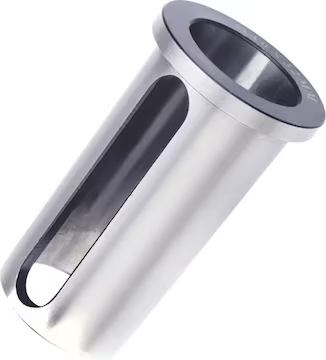
What Are Bushings and Why Are They Important?
Bushings are precision-ground cylindrical components that support rotating or stationary tools within sleeves or housings. In turret assemblies, bushings help in:
- Reducing friction
- Supporting rotating tools
- Preventing metal-to-metal wear
- Maintaining radial accuracy
High-quality bushings ensure longer tool life and protect expensive turret assemblies from premature damage.
How Turret Sleeves & Bushings Improve CNC Accuracy?
Precision machining requires microns-level tolerance control. Turret sleeves and bushings contribute in the following ways:
1. Concentric Tool Alignment
Properly manufactured sleeves prevent tool deviation from the centerline. This minimizes runout and ensures symmetrical cutting.
2. Vibration Control
Stable holding reduces chatter marks and enhances surface finish.
3. Tool Life Extension
Accurate support reduces uneven wear on cutting edges.
4. Consistent Batch Production
Repeatable positioning ensures every part meets the same tolerance.
In industries like automotive and aerospace, these small components directly influence product quality.
Materials Used in Turret Sleeves & Bushings
To perform under high cutting forces and temperature variations, turret sleeves and bushings are typically made from:
- Hardened alloy steel
- Case-hardened steel
- Tool steel
- Heat-treated precision ground materials
The heat treatment process increases wear resistance and dimensional stability, especially during heavy-duty machining operations.
Types of Turret Sleeves Used in CNC Lathes
Different CNC machines require different sleeve configurations.
Straight Sleeves
Used for holding fixed shank tools in turret stations.
Tapered Sleeves
Provide improved self-centering and grip.
Floating Sleeves
Allow slight movement to absorb minor misalignment.
Driven Tool Sleeves
Used in live tooling applications where rotation is involved.
Compatibility with other tooling systems such as Collet chucks can further enhance flexibility in tool holding applications.
Role of Bushings in Live Tooling
Live tooling systems require high rotational stability. Bushings in such setups:
- Support rotating shafts
- Reduce axial movement
- Maintain alignment at high RPM
Improper bushing design can cause overheating, vibration, and bearing failure. That is why precision-ground bushings are critical for CNC turret longevity.
Common Problems Caused by Poor Quality Sleeves & Bushings
Low-quality or worn-out components can lead to:
- Tool runout beyond acceptable limits
- Poor surface finish
- Increased scrap rate
- Tool breakage
- Spindle load imbalance
- Machine downtime
Even if you use premium tooling systems like ER collets, the performance will suffer if the sleeve and bushing support system is weak.
How to Choose the Right Turret Sleeve & Bushing
Selecting the correct components depends on:
1. Machine Model
Always match dimensions with OEM specifications.
2. Tool Shank Size
Ensure proper fit to avoid micro-movement.
3. Application Type
Heavy cutting requires hardened, high-load sleeves.
4. RPM Range
Live tooling applications demand superior balance and finish.
5. Tolerance Requirements
High-precision industries require ultra-low runout control.
Shops that use standardized systems like 5C collets often benefit from interchangeable and accurately machined support sleeves.
Maintenance Tips for Longer Life
Proper maintenance extends the life of turret sleeves and bushings.
- Clean tool holders before installation
- Avoid overtightening
- Inspect for wear marks regularly
- Lubricate where recommended
- Replace damaged components immediately
Preventive maintenance is always more cost-effective than reactive repair.
Integration with Other Precision Tooling Systems
Turret sleeves and bushings work as part of a larger tool holding ecosystem. In advanced machining setups, they are often used alongside:
- Precision collet systems
- Modular tool holders
- Live tooling attachments
- Custom automatic lathe accessories
In legacy automatic lathes, components such as Traub collets also rely on accurate support systems for maintaining part quality in high-speed repetitive production.
Similarly, standardized European systems like Din collets depend on dimensional accuracy across all mating components, including sleeves and bushings.
Why Manufacturing Quality Matters?
The difference between average and exceptional machining performance often lies in manufacturing precision.
A trusted Collets Manufacturer focuses on:
- Strict dimensional tolerance control
- Precision cylindrical grinding
- Controlled heat treatment
- Surface hardness testing
- Runout inspection
Such standards ensure that turret sleeves and bushings maintain micron-level alignment under continuous industrial use.
Why Sikka Collets Stands Out in Precision Engineering?
Sikka Collets has established a strong reputation in the field of precision workholding solutions. The company specializes in manufacturing high-accuracy collets, sleeves, and related tooling components designed for demanding industrial applications.
What differentiates them is their engineering-driven approach. Instead of mass-producing generic parts, they emphasize:
- Consistent material quality
- Advanced heat treatment processes
- Strict quality checks
- Long service life
- Reliable industrial performance
Their products are widely used in automotive, electrical, fastener, and general engineering sectors where precision cannot be compromised.
By combining manufacturing expertise with modern inspection methods, they ensure that every component contributes to higher machining efficiency and reduced downtime.
Final Thoughts: Small Components, Big Impact
Turret sleeves and bushings may seem like minor machine components, but they form the structural backbone of CNC turret precision. Without them:
- Tools cannot maintain alignment
- Repeatability suffers
- Surface finish declines
- Machine life reduces
If your machining accuracy is not meeting expectations, inspecting your turret sleeves and bushings might reveal the root cause. Investing in precision-engineered components is not an expense — it is a long-term performance strategy.