
Expert Guide for Precision Machining Professionals
In modern machining environments, precision workholding is not optional — it is critical. Among the most widely used systems in tool rooms, CNC setups, and grinding applications are 5C collets. While many machinists understand their general use, fewer fully understand the importance of internal and external threads with different pitch variations in 5C collets.
This expert guide explains everything you need to know — thread types, pitch standards, compatibility, applications, selection tips, and common mistakes — so you can make informed, technically sound decisions.
Understanding the Basic Structure of 5C Collets
A standard 5C collet is a precision-machined, hardened steel workholding device designed to clamp round, hexagonal, or square stock with high concentric accuracy.
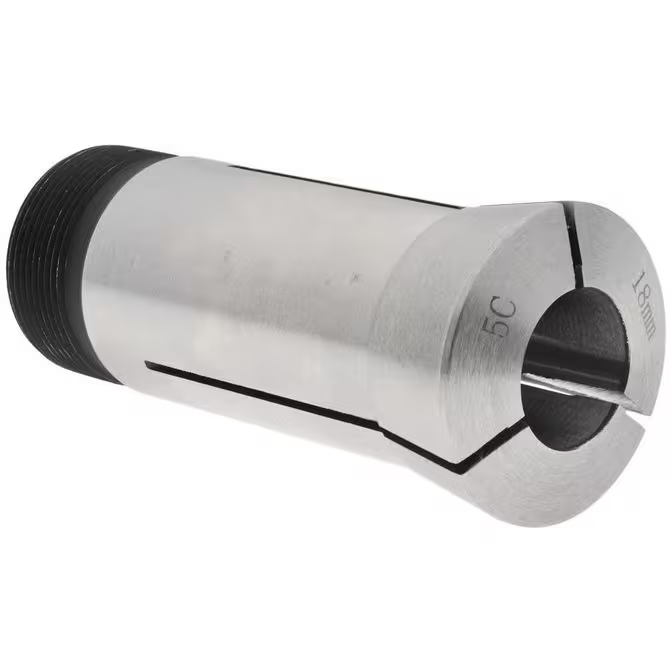
The standard configuration typically includes:
- External thread at the rear (commonly 1.238″-20 UNEF)
- Internal bore for gripping material
- Longitudinal slots for compression
- Hardened and ground body for durability
However, variations exist where internal and external threads may differ in pitch, depending on application requirements.
What Does Thread Pitch Mean in 5C Collets?
Thread pitch refers to the distance between adjacent threads. In inch-based systems, pitch is expressed as Threads Per Inch (TPI). In metric systems, it is measured in millimeters.
In 5C collets:
- The external thread is used to engage with a drawbar or collet closer.
- The internal thread may be used in certain customized or extended collet designs.
Different pitch combinations can affect compatibility, clamping force, and mechanical stability.
Why Do Some 5C Collets Have Different Thread Pitches?
Thread variations are not random. They are engineered for specific operational needs.
1. Machine Compatibility Requirements
Not all lathes, grinders, or indexing heads use identical drawbar systems. Some imported or customized machines require non-standard thread pitch configurations.
If the external thread pitch does not match the machine’s drawbar, the collet will not seat correctly — leading to poor concentricity or mechanical damage.
2. Custom Industrial Applications
In specialized industries such as aerospace component manufacturing or medical device machining, certain setups require:
- Modified internal threading
- Extended nose collets
- Step collets with altered pitch
- Emergency collets customized by machining
In these cases, pitch variation helps maintain structural strength while accommodating application-specific tooling.
3. Load Distribution and Clamping Force
Thread pitch influences how force is distributed during tightening.
- Finer pitch threads provide greater axial clamping force.
- Coarser pitch threads allow faster engagement and disengagement.
The selection depends on whether speed or precision force control is the priority.
Internal Threading in 5C Collets – When Is It Used?
Standard 5C collets primarily rely on external threading. However, certain variations include internal threading for:
- Expanding collet systems
- Mandrel-based gripping
- Stop rod mechanisms
- Custom automation systems
These designs are less common but crucial in high-precision manufacturing environments.
External Threading – The Standard Specification
Most standard 5C collets use:
1.238″-20 TPI external thread
This thread connects to:
- Manual drawbars
- Pneumatic collet closers
- Hydraulic systems
- Lever-type closers
Thread tolerance must be maintained precisely. Even minor deviations can cause:
- Runout problems
- Thread stripping
- Uneven clamping
- Premature wear
That is why sourcing from a reliable Collets Manufacturer is critical to ensure proper dimensional control and hardened threading integrity.
Common Thread Pitch Variations in the Industry
While 1.238″-20 TPI is standard, other pitch modifications may include:
- Metric conversions for imported machinery
- Custom pitch designs for OEM machines
- Modified thread lengths for special collet closers
Always confirm:
- Machine manual specifications
- Drawbar thread compatibility
- Collet closer system requirements
Using incorrect pitch may damage both the collet and spindle assembly.
How Thread Differences Affect Performance?
Let us break this down technically:
1. Concentricity Stability
Improper pitch engagement can create slight axial misalignment, increasing Total Indicated Runout (TIR).
2. Thread Wear Over Time
Incorrect pitch pairing accelerates:
- Galling
- Thread flattening
- Reduced clamping reliability
3. Safety Risks
High-speed machining demands secure engagement. A mismatched pitch under RPM load is a serious safety hazard.
Comparing Threaded 5C Systems with Other Collet Types
It is useful to understand how 5C threading compares with other collet systems.
For example, ER collets do not use the same external thread design. They rely on collet nuts and tapers rather than rear threading.
Similarly, systems like Collet chucks hold collets inside a chuck body instead of direct threaded drawbar engagement.
This structural difference makes 5C threading especially critical in axial clamping systems.
Selecting the Right Threaded 5C Collet
Before purchasing, confirm the following:
1. Machine Make and Model
Check manufacturer documentation.
2. Thread Standard (Inch or Metric)
Verify if it is 20 TPI or custom pitch.
3. Application Type
High-speed? Heavy load? Repetitive production?
4. Closer System
Manual, pneumatic, hydraulic, or CNC-actuated?
5. Required Accuracy Level
Tool room vs. production-grade tolerance.
Maintenance Tips for Threaded 5C Collets
Thread life can be extended through:
- Regular cleaning
- Avoiding over-tightening
- Lubricating threads lightly
- Checking for burrs or wear
- Using matched drawbars
Never force engagement if resistance feels abnormal. Always inspect pitch alignment before tightening.
Why Quality Manufacturing Matters in Threaded Collets?
Thread cutting and grinding require extremely tight tolerances. Even slight pitch error can:
- Reduce lifespan
- Compromise clamping force
- Affect spindle health
High-quality collets undergo:
- Precision thread rolling or grinding
- Heat treatment for surface hardness
- Stress relieving processes
- Dimensional inspection using gauges
Industrial-grade threading ensures consistent torque transfer and axial force.
Sikka Collets – Precision Engineering with Reliability
When it comes to precision-threaded collets, Sikka Collets has established a reputation for technical reliability and industrial performance. With decades of engineering expertise, the company focuses on manufacturing high-accuracy collets that meet strict dimensional tolerances and production demands.
Their facility emphasizes:
- Controlled heat treatment
- Advanced CNC grinding
- Rigorous inspection standards
- Durable hardened threading
- Long service life under heavy usage
Sikka Collets supplies precision solutions for tool rooms, CNC units, OEM manufacturers, and production workshops across industries.
Their experience ensures that whether you require standard 20 TPI external threading or customized pitch modifications, the product maintains strength, alignment, and reliability even under continuous operation.
Final Expert Recommendation
5C collets with internal and external threads of different pitch are not common in basic setups, but they are critical in specialized and high-precision machining environments.
Before selecting:
- Always verify machine thread specification.
- Confirm compatibility with your drawbar or closer.
- Choose hardened, ground, and inspected threading.
- Avoid mixing incompatible pitch standards.
Precision machining demands precise thread engagement. A small mismatch can cause large production losses. By understanding thread pitch variations and sourcing from trusted engineering manufacturers, you protect both your equipment and your output quality.